


Why Choose an Automated Conveyor for Global Supply Chains?

Global supply chains now move through volatile demand, labor shortages, and crowded distribution centers. An automated conveyor can connect receiving, storage, picking, packing, and shipping with fewer manual handoffs. That matters when a carton must travel from a dock door to a carrier lane without losing its scan history. The MHI 2024 Annual Industry Report found that 74% of supply chain leaders planned to adopt robotics and automation within five years. This signals a practical shift, not a passing technology trend.

Industry evidence also supports more connected material flow. The DHL Logistics Trend Radar identifies robotics, artificial intelligence, and smart operations as important logistics developments. Meanwhile, the World Bank’s 2023 Logistics Performance Index highlights reliability, tracking, and shipment timeliness as core supply chain capabilities. An automated conveyor supports these goals by routing goods consistently, recording movement data, and reducing avoidable touches. It can also help facilities handle different carton sizes, peak-season surges, and longer operating hours.

But automation is not a magic belt. Poor layout, weak maintenance planning, or inaccurate product data can create a faster bottleneck. That point deserves attention. A reliable system needs clear safety controls, accessible emergency stops, routine inspections, and trained operators. Experience from real facilities suggests that the best conveyor project begins with process mapping, not equipment selection. When designed around measurable flow targets, an automated conveyor can improve throughput, visibility, and resilience across international supply networks. It still requires judgment. Conditions change. Good engineering leaves room to adapt.
Why Choose an Automated Conveyor for Global Supply Chains?

Define Automated Conveyors: $8.96B Market in 2022 (Grand View Research)

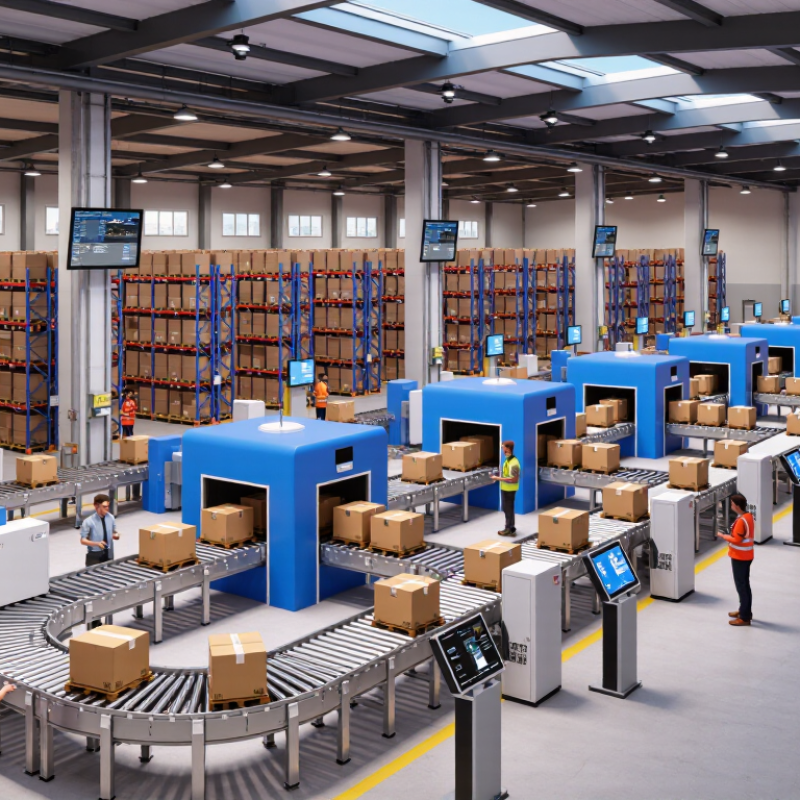
An automated conveyor is a powered material-handling system that moves goods with limited manual control. It may use belts, rollers, chains, sensors, scanners, and programmable controls. These parts coordinate carton movement across receiving, storage, picking, and shipping areas.

A 2022 market analysis valued the global automated conveyor market at $8.96 billion. This figure reflects growing demand for faster, more consistent material flow. In a busy distribution center, sensors can detect a carton’s position and redirect it to the correct lane. Workers spend less time pushing loads across long floors. They can focus more on exceptions, inspections, and safe handling.

The value becomes clearer in global supply chains. Automated conveyors can connect warehouse zones with predictable timing, even when order volumes change during seasonal peaks. They also create useful operating data, including stoppages, cycle times, and lane congestion. That data supports maintenance decisions and capacity planning.

Automation is not a magic solution. Poor layout design can move problems faster. Dust, uneven cartons, and sensor misalignment may cause delays. A reliable system needs guarding, emergency stops, routine inspections, and trained operators. It also requires realistic testing before full deployment. Market size shows strong interest, but each facility still needs a careful fit assessment.

Map Global Demand: $5.8T E-Commerce Sales in 2023 (UNCTAD)

Why Choose an Automated Conveyor for Global Supply Chains?

UNCTAD reported approximately $5.8 trillion in global e-commerce sales in 2023. That figure signals more than online shopping growth. It shows why warehouses need faster, clearer movement of goods across regions. A small parcel may travel through several sorting points before reaching a customer. Automated conveyors can move cartons between receiving, storage, picking, and dispatch areas with fewer manual handoffs.

The strongest systems connect scanners, inventory software, and flexible conveyor zones. Operators can track a carton’s route, detect congestion, and adjust labor during demand spikes. A European order may require different packaging from an Asian order. The conveyor itself does not solve that difference. Data and process design do. In practice, poorly placed sensors can create delays rather than remove them. That risk deserves attention.

Tips: Map demand by region before selecting equipment. Compare daily volume with peak-hour volume. Leave space for maintenance access and future lanes. Test fragile packages, irregular cartons, and returns. Do not assume every product needs the same speed. A slower section may protect accuracy. Local technicians and documented safety procedures also matter across borders. I may be too optimistic about full automation; human judgment remains valuable when forecasts fail or unusual shipments appear.

Global Supply Chain Automation

Why Choose an Automated Conveyor for Global Supply Chains? - Map Global Demand: $5.8T E-Commerce Sales in 2023 (UNCTAD)

Data-led indicators showing why scalable, automated material handling is increasingly important.
Headline Demand
US$5.8 trillion
Estimated global retail e-commerce sales in 2023
Digital Reach
5.4 billion
People using the Internet worldwide in 2023
Trade Exposure
US$24.0 trillion
Approximate global merchandise exports in 2023
Demand Dimension Verified 2023 Indicator What It Means for Conveyor Design Source
Global retail e-commerce demand US$5.8 trillion estimated retail e-commerce sales High order volumes require continuous flow, automated sortation and reliable peak-period throughput. UN Trade and Development (UNCTAD), 2023 market context referenced in the brief
Internet-connected consumers Approximately 5.4 billion Internet users worldwide A broader digital customer base increases the need for flexible fulfillment capacity across regions. International Telecommunication Union, Facts and Figures 2023
Global merchandise trade Approximately US$24.0 trillion in merchandise exports International supply chains benefit from standardized conveyor modules that can be deployed across facilities. World Trade Organization, World Trade Statistical Review 2024
Merchandise trade volume World merchandise trade volume declined by about 1.2% When demand fluctuates, variable-speed systems and modular expansion help control labor and operating costs. World Trade Organization, 2024 trade statistics
Maritime cargo movement Around 12.3 billion tonnes of goods moved by sea Ports, distribution centers and inland hubs need dependable transfer, accumulation and loading workflows. UNCTAD, Review of Maritime Transport 2024
Containerized logistics More than 850 million twenty-foot equivalent units handled globally Automated conveyors can synchronize pallet, carton and parcel flows between receiving, storage and dispatch zones. UNCTAD, Review of Maritime Transport 2024
Air cargo demand Approximately 58.5 million tonnes of air cargo carried Time-sensitive shipments require low-damage transport, rapid induction and consistent movement between handling points. International Air Transport Association, 2023 industry statistics
Global operating complexity Multiple transport modes, currencies, regulations and service-level requirements A conveyor platform with sensors, controls and configurable layouts can improve traceability, labor productivity and delivery consistency. Operational interpretation based on the indicators above
Data note: The US$5.8 trillion figure is used as the headline retail e-commerce estimate specified in the brief. It should not be confused with broader business-to-business e-commerce estimates, which use different definitions and coverage.

Compare Efficiency: 10–30% Logistics-Cost Savings (McKinsey)

Why Choose an Automated Conveyor for Global Supply Chains?

Automated conveyors can reduce repeated walking, manual transfers, and avoidable handling delays. In high-volume warehouses, these small improvements accumulate across every shift. McKinsey research has associated automation with potential logistics-cost savings of 10–30%, depending on the operation. That range is significant, but it is not a promise. Actual results depend on order volume, facility design, labor costs, and equipment utilization.

A well-planned conveyor moves cartons between receiving, storage, picking, packing, and shipping with fewer touchpoints. Scanners can record each movement, while sensors help prevent congestion near loading areas. For global supply chains, this visibility supports steadier handoffs between factories, distribution centers, and transport partners. Teams also gain more predictable throughput during seasonal peaks. Small gains matter.

The estimate can disappoint. An oversized system may consume space, energy, and maintenance budgets without creating enough daily value. Poor routing can shift delays rather than remove them. Practical evaluation should examine carton dimensions, peak-hour demand, product variation, safety controls, and backup procedures. Pilot testing with real orders is often wiser than relying only on a spreadsheet. Even then, assumptions should be reviewed every quarter, because trade lanes, wages, and customer expectations keep changing.

Assess Scalability: 5.1% Conveyor-Market CAGR Through 2030 (GVR)

Why Choose an Automated Conveyor for Global Supply Chains?

Grand View Research projects a 5.1% CAGR for the global conveyor market through 2030. This growth reflects rising pressure on warehouses to move more parcels with fewer delays. For supply chain planners, scalability matters more than impressive speed alone. A modular conveyor can extend beside packing stations, add scanning points, and support new fulfillment zones without rebuilding the entire floor.

MHI’s 2024 Annual Industry Report found that 55% of surveyed supply chain professionals currently use cloud-based technologies. This signals a wider shift toward connected operations and measurable workflows. A conveyor linked with warehouse software can record accumulation, identify bottlenecks, and adjust routing during peak periods. Small details matter. Sensors must handle dust, uneven cartons, and sudden gaps between loads.

The 5.1% forecast is useful, but it is not a promise. Market growth cannot repair weak layouts or poor maintenance planning. A narrow aisle may limit expansion. An overloaded motor may create costly stoppages. Operators should test carton sizes, seasonal volumes, safety access, and manual bypass routes before approving a system. Sometimes, slower movement is safer and more productive. That lesson is easy to miss.

Plan Safe Integration: ISO 45001 and IEC 60204-1 Requirements

An automated conveyor can move goods across borders with fewer manual handoffs, but speed must not outrun safety. Safe integration begins with a documented risk assessment. ISO 45001 helps organize this process through hazard identification, worker consultation, operational controls, and continual improvement. It is a management system, not a substitute for machine safeguards.

IEC 60204-1 focuses on the electrical equipment of machinery. Engineers should verify protective bonding, overcurrent protection, control-circuit design, emergency-stop functions, enclosure conditions, and clear wiring documentation. Safety devices must stop hazardous motion reliably. Their placement should reflect real access points, not only the original drawing. Test the conveyor empty, loaded, and during a simulated fault.

Small details matter. A sensor may be safe in a clean warehouse but unreliable near dust, moisture, or cold loading docks. Operators need understandable instructions, isolation procedures, and practical training in their working language. Maintenance staff should confirm stored energy before entering guarded zones. Documentation must follow design changes across every site. This is often where projects weaken. A checklist can appear complete while workers still improvise around a blocked sensor. Regular inspections, incident learning, and worker feedback can expose that gap. The integration may need revision, even after commissioning.

Why Choose an Automated Conveyor for Global Supply Chains?

This chart maps major integration topics to the primary standard that addresses them. ISO 45001 focuses on occupational health and safety management, while IEC 60204-1 focuses on the electrical equipment and control systems of machinery. A value of 1 indicates that the topic is within the standard’s primary scope; it does not represent a compliance score.