






Buying reliable Battery Testers in 2026 requires more than comparing screen size, price, or advertised accuracy. Global buyers need instruments that measure capacity, voltage, internal resistance, discharge performance, and temperature consistently. A workshop testing 18650 cells has different needs from an electric vehicle service center. Even a small calibration error can distort a battery’s health report.
Battery researcher Jeff Dahn has stated, “Lithium-ion batteries are not a mature technology.” That observation still matters. Cell chemistry changes, charging systems evolve, and testing methods must keep pace. The best Battery Testers combine stable current control, clear data logging, repeatable results, and practical safety protections. They should also support common formats, including cylindrical cells, pouch cells, lead-acid batteries, and lithium iron phosphate packs.
This guide examines ten leading Battery Testers for global buyers in 2026. Each option is considered through accuracy, operating range, software quality, durability, user experience, and after-sales support. Certification evidence matters. So does the availability of replacement leads and calibration services. Some models look impressive but perform poorly under continuous loads. Others are less polished, yet deliver dependable measurements every day.
No ranking can fit every laboratory or repair bench. That is worth admitting. Import duties, regional voltage standards, language support, and local service networks may change the final decision. Readers should verify current specifications before purchasing. A tester is not a battery expert. It is only a measurement tool, and careless setup can still produce misleading conclusions.
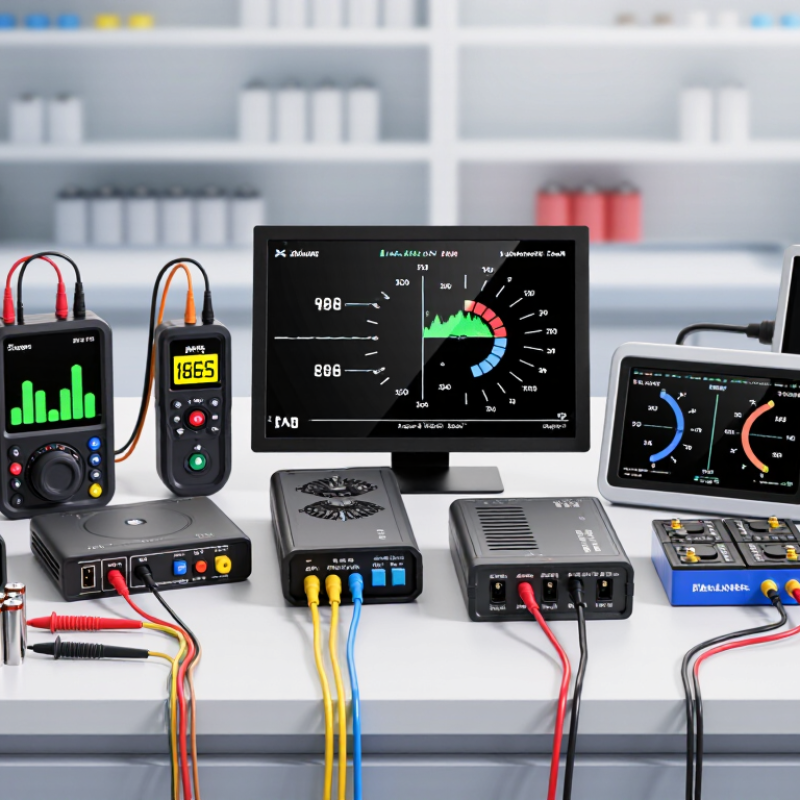
For global buyers, a battery tester is more than a voltage meter. It should measure voltage, current, temperature, capacity, and charge or discharge behavior. Look for programmable test profiles, protected terminals, calibrated sensors, and time-stamped data records. A stable chamber can expose failures that appear only in heat or cold. Small details matter.
IEC 62133-2 focuses on the safety of portable lithium cells and batteries during expected use. Test equipment should support controlled charging, external short-circuit checks, vibration, mechanical shock, overcharge, and abnormal operation tests. UL 1642 examines lithium battery construction and abuse performance, including insulation, pressure, temperature, and short-circuit behavior. These standards are related, but they are not interchangeable. Not a certificate.
UN 38.3 addresses transport safety through tests such as altitude simulation, thermal cycling, vibration, shock, external short circuit, impact, overcharge, and forced discharge. A suitable tester should reproduce these conditions carefully and preserve clear records for technical review. A test summary may support shipping documentation, but the instrument alone cannot prove compliance. That distinction matters. In practice, operators should verify calibration dates, fixture condition, software limits, and emergency shutdown functions. I have found that rushed setup creates misleading results, especially when contact resistance is ignored. No tester fixes poor method. Independent laboratory assessment may still be necessary, and requirements can change with battery design, pack size, and destination.
| Rank | Tester Type | Typical Battery Scope | Typical Electrical Capability | Main Measurements | Relevant Standard Activities | Required Accessories or Controls | Best Buyer Profile |
|---|---|---|---|---|---|---|---|
| 1 | Programmable Battery Cycler | Lithium-ion cells, modules and packs | 0–150 V; 0–300 A per channel; regenerative systems available | Voltage, current, capacity, energy, power, cycle count and temperature | Charge/discharge conditioning, overcharge and cycle testing supporting IEC 62133-2 and UL 1642 test programs | Four-wire sensing, thermal chamber, cell fixtures, emergency shutdown and data logging | Certification laboratories, battery developers and high-volume manufacturers |
| 2 | High-Precision Cell Analyzer | Coin cells, cylindrical cells and pouch cells | 0–6 V; approximately 0–10 A per channel; microampere-range operation available | Low-current capacity, coulombic efficiency, open-circuit voltage and self-discharge | Performance characterization and pre-compliance conditioning before IEC 62133-2 or UL 1642 evaluation | Kelvin leads, calibrated shunts, low-noise channels and temperature sensors | R&D teams, cell laboratories and incoming-quality inspection departments |
| 3 | Battery Pack End-of-Line Tester | Consumer, industrial and light-electric-vehicle packs | Up to 1,000 V DC; current capability selected for pack rating | Pack voltage, current, contactor operation, insulation resistance and communication signals | Production verification related to electrical safety, BMS operation and pack-level documentation | Automated fixtures, CAN or other vehicle-network interface, interlocks and guarded test enclosure | Pack manufacturers and automated production lines |
| 4 | Battery Internal-Resistance Meter | Primary cells, rechargeable cells, modules and UPS batteries | Low-voltage measurement using AC or pulse methods; current varies by instrument | AC impedance, DC resistance, terminal voltage and conductance | Screening, matching and aging checks; not a complete substitute for IEC 62133-2, UL 1642 or UN 38.3 testing | Four-terminal probes, clean contacts, temperature control and reference standards | Service centers, warehouse inspection and production screening |
| 5 | Battery Safety Test System | Rechargeable lithium-ion cells and small battery packs | Integrated charge/discharge source with programmable limits and fault conditions | Temperature, voltage, current, pressure, venting and abnormal-event status | Abuse and abnormal-operation sequences associated with IEC 62133-2 and UL 1642 | Fire-rated chamber, exhaust system, pressure relief, video monitoring and remote shutdown | Safety laboratories and compliance engineering departments |
| 6 | Thermal-Chamber Battery Cycler | Cells, modules and battery packs requiring environmental conditioning | Cycler voltage and current selected according to the device under test; chamber commonly −40 °C to +150 °C | Capacity retention, charge acceptance, thermal response and voltage stability | Temperature-dependent charging, discharging and conditioning used in qualification programs | Uniformity verification, chamber safety interlock, feedthroughs and multiple temperature probes | Global product developers and laboratories testing different climate conditions |
| 7 | UN 38.3 Transport-Test Instrument Set | Lithium-ion and lithium-metal cells and batteries prepared for transport | Electrical cycling hardware combined with environmental and mechanical test equipment | Voltage, capacity, temperature, pressure response, impact, vibration and external short-circuit behavior | T.1–T.8 test sequence under the UN Manual of Tests and Criteria, Part III, subsection 38.3 | Altitude chamber, thermal chamber, vibration table, shock equipment, short-circuit load and impact apparatus | Dangerous-goods laboratories, exporters and logistics compliance teams |
| 8 | BMS Diagnostic and Communication Tester | Smart battery packs with monitoring and protection electronics | Pack voltage and current range matched to the battery; programmable electronic load often included | State-of-charge estimates, cell balancing, fault flags, temperature inputs and communication frames | Functional verification supporting safety testing; it does not replace destructive compliance tests | CAN, SMBus or UART interface, simulated cell inputs, programmable loads and software logging | BMS developers, repair centers and pack integration teams |
| 9 | High-Voltage Insulation and Hipot Tester | High-voltage modules, packs, chargers and insulated enclosures | AC or DC withstand testing with insulation-resistance measurement; voltage depends on the test plan | Leakage current, dielectric withstand, insulation resistance and ground continuity | Electrical safety screening and production verification used alongside applicable battery standards | Guarding, discharge circuit, interlocked enclosure, HV warning indicators and calibrated leads | High-voltage battery-pack manufacturers and end-of-line inspectors |
| 10 | Portable Field Battery Analyzer | Small rechargeable packs, power banks and service batteries | Typically 0–60 V and low-to-medium discharge current | Voltage, estimated capacity, resistance, charge status and basic discharge curves | Maintenance and preliminary screening only; formal IEC 62133-2, UL 1642 and UN 38.3 work requires validated equipment and procedures | Portable probes, replaceable leads, internal memory and calibration verification | Field-service engineers, installers, distributors and small laboratories |
