






Choosing an Affordable Smartwatch manufacturer in China takes more than comparing unit prices. Buyers should also examine product quality, customization options, production capacity, and communication. A low quotation can look attractive, but it may exclude packaging, testing, or software changes. Details matter.
This guide introduces ten manufacturers for buyers exploring China’s smartwatch supply base. It considers practical factors such as display types, battery performance, health-tracking features, companion apps, and minimum order quantities. These details help clarify which suppliers may fit a particular product brief and budget. Specs can mislead. A feature listed in a catalog does not always perform equally well across models, so samples and clear testing requirements are useful.
The companies discussed may serve different needs, from entry-level retail products to customized devices for established brands. No single supplier is right for every project. A first-time buyer may value responsive support, while a larger brand may prioritize stable production and consistent quality checks. This shortlist is a starting point, not a guarantee of performance or the lowest total cost. Manufacturer information and product offerings can change, and available evidence may not answer every question. Compare current quotations, request recent samples, and confirm specifications directly before making a decision. A careful review takes time. That part is easy to underestimate.
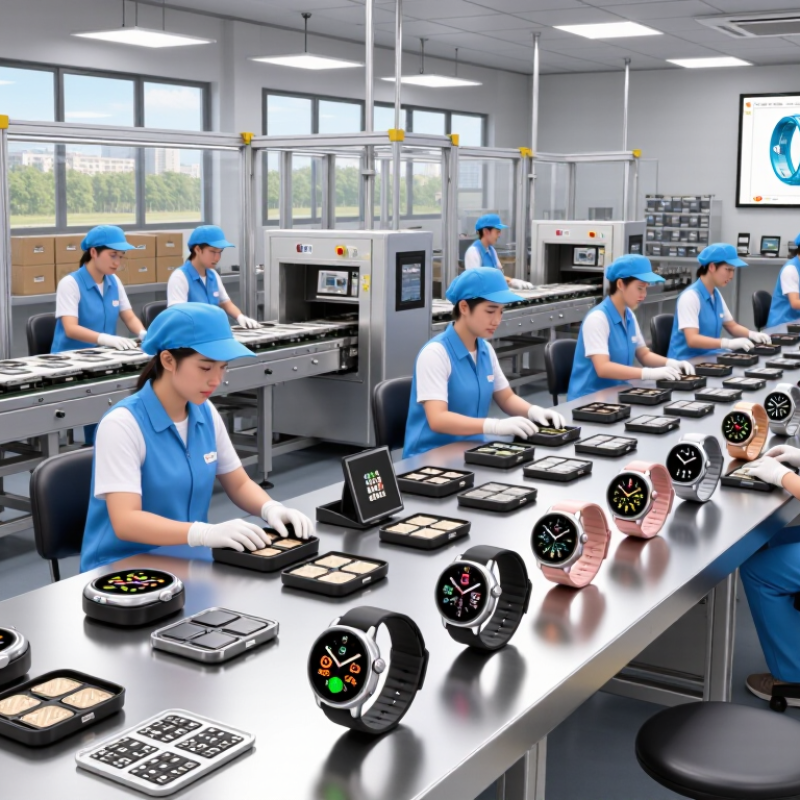
An affordable smartwatch is not simply the cheapest device on a shelf. It is a watch that offers dependable core functions at a price suited to its target market. Those functions may include step counting, basic heart-rate tracking, phone notifications, and a readable screen. “Affordable” is relative. A price that works for one buyer may be high in another region.
Specifications need practical checks. A bright display can be hard to read outdoors, and advertised battery life may change with frequent notifications or health tracking. Look for clear information about sensor limits, app compatibility, warranty support, and quality testing. Small details matter. For example, a charging cable that is difficult to replace can make a low purchase price less attractive.
Manufacturer scope also needs a clear definition. A factory may design products, assemble supplied components, or produce watches to a buyer’s specification. These roles are not interchangeable. A useful manufacturer comparison should check production capability, sample quality, communication, and the ability to document testing. It should also distinguish direct manufacturers from trading companies where possible. Public information can be incomplete, so any “top 10” list should explain its selection criteria rather than imply a definitive ranking. That distinction is easy to miss.

China’s smartwatch manufacturing ecosystem is a network, not a single factory. Component suppliers provide screens, batteries, sensors, casings, and circuit boards. Design teams turn these parts into a wearable product, while assembly plants handle production and packaging. Some manufacturers manage several stages; others rely on specialist partners. This structure can keep costs competitive, but quality depends on coordination. A delayed screen shipment can hold up an entire production run. Small details matter.
Affordable models often use established components and shared design platforms, then adjust materials, software, or features for different buyers. Testing should cover more than whether the watch turns on. Check battery performance across several days, sensor consistency during ordinary movement, and water resistance under stated test conditions. Ask who handles firmware updates and how defects are recorded. Factory capabilities vary, and a polished sample may not represent every production batch. That gap deserves attention.
Tips: Request a working sample and a written specification. Compare actual test results with the product claims, and clarify minimum order quantities, inspection steps, and warranty handling. One visit is useful, not conclusive. A little skepticism helps.
A typical smartwatch production workflow, from product engineering to shipment.
The numbers show workflow order only—not market share, factory capacity, or supplier rankings. In practice, some stages overlap and supplier arrangements vary by product.
When evaluating affordable smartwatch manufacturers in China, compare working samples rather than relying on catalogue photos. Check screen brightness indoors and outdoors, touch response with dry fingers, and whether the watch stays connected during a short walk. Small details matter. Ask for battery test conditions, since screen settings and notification frequency can change reported runtime.
Review the component specifications and how consistently each unit is assembled. Test heart-rate readings at rest and after light movement, but do not treat a smartwatch as a medical device. Ask how the manufacturer checks sensors, water resistance, charging, and software updates. Request written quality-control procedures and relevant test documents. One sample is not enough; a small production run may reveal uneven buttons, loose charging contacts, or inconsistent displays.
Price needs context. Compare minimum order quantities, packaging costs, tooling charges, lead times, warranty terms, and replacement procedures. Clear answers are a useful sign of reliable communication. Ask who handles app maintenance and how defects are recorded after delivery. Low cost can be attractive, but it may come with trade-offs in materials or support. These criteria are imperfect, too: a polished sample cannot guarantee every future batch will match.
Use these criteria to compare suppliers. The weights are suggested evaluation weights, not measured rankings. Request current documents and verify specifications against the exact model being quoted.
| No. | Evaluation criterion | Suggested weight | What to check | Evidence to request |
|---|---|---|---|---|
| 1 | Total landed cost | 16% | Compare unit price alongside tooling, packaging, customization, shipping terms, duties, and any recurring software or service charges. | A written quotation with currency, Incoterm, order quantity, included accessories, tooling charges, and quote validity. |
| 2 | Product quality system | 14% | Assess documented incoming inspection, in-process checks, final testing, defect handling, and traceability. An ISO 9001 certificate can support the review but does not by itself prove product quality. | Current quality-system certificate, sample inspection records, test checklist, defect-correction process, and batch traceability example. |
| 3 | Battery safety and shipping readiness | 12% | Confirm the battery specification, protection features, charging requirements, and applicable transport documentation for the shipment. | Battery datasheet and applicable UN 38.3 test summary for the lithium battery type offered; confirm that documents match the product configuration. |
| 4 | Product safety and market compliance | 12% | Identify the destination markets and check the applicable requirements for the complete device, charger, radio functions, and materials. Requirements vary by market and model. | Relevant, current test reports or declarations for the exact model and market. Where applicable, review electrical-safety testing, EMC/radio documentation, and RoHS or REACH material documentation. |
| 5 | Water-resistance claim validation | 10% | Check whether the advertised rating is supported by testing and whether operating limits, maintenance instructions, and warranty exclusions are clearly stated. | A test report for the offered model referencing the applicable IP classification method, such as IEC 60529 where relevant; do not treat a rating as a guarantee for every use condition. |
| 6 | Bluetooth and app compatibility | 10% | Test pairing, notifications, synchronization, supported phone operating systems, language coverage, and app maintenance. Confirm Bluetooth qualification obligations for the product. | Demonstration on representative phones, compatibility list, app update history, support plan, and applicable Bluetooth SIG qualification details. |
| 7 | Production capacity and lead time | 9% | Compare the quoted production schedule, capacity allocation, component availability, and peak-season planning. Treat lead time as order- and configuration-specific. | A written schedule covering sample approval, production, inspection, and shipment, plus a capacity plan for the requested quantity. |
| 8 | Customization and minimum order quantity | 7% | Clarify available changes to color, straps, packaging, interface, firmware, and language, as well as the MOQ and cost for each option. | A model-specific customization matrix stating MOQ, development charges, sample timeline, and which changes affect compliance testing. |
| 9 | Warranty and after-sales support | 6% | Review warranty duration and scope, return handling, spare-part availability, response times, and responsibility for software-related issues. | Written warranty terms, RMA workflow, support contact process, spare-parts policy, and stated response-time commitments. |
| 10 | Data privacy and health-claim controls | 4% | Understand what personal data the app collects, where it is processed, how users can delete it, and whether health-related functions are presented with appropriate limitations. | Privacy policy, data-flow explanation, app permission list, deletion process, and substantiation for any health or medical claims made for the product. |
| Total suggested weight | 100% | Score each criterion using the same evidence standard for every supplier. | ||
Note: These are evaluation criteria, not claims about any specific manufacturer or product. Verify certificates, test reports, specifications, and commercial terms for the exact model and destination market.
China’s affordable smartwatch suppliers differ more in engineering depth than in appearance. IDC estimated global wearable-device shipments reached 534.6 million units in 2024, up 6.1% year over year. This broad category includes more than smartwatches, so it signals market scale, not smartwatch demand alone. The ten profiles below are anonymized supplier archetypes, not endorsements of named factories.
A Shenzhen ODM may offer custom firmware and app integration. A Dongguan assembler may focus on high-volume production. A Huizhou supplier may specialize in sensor integration. A Guangzhou engineering-led exporter may coordinate design and sourcing. A Zhongshan maker may prioritize low-cost plastic cases. An Xiamen design-focused factory may refine comfort and screen layout. A Hangzhou supplier may bring stronger software capabilities. A Ningbo producer may specialize in straps and components. A Foshan workshop may handle metal housings. A Suzhou supplier may offer testing and supply-chain coordination. These profiles are useful starting points, but real capabilities vary by factory.
Tips: Request a working sample, battery-life test conditions, and a written component list. Ask who owns the firmware and what changes cost extra. A low quote can hide weak documentation; I would verify that before comparing prices.
Comparing China’s affordable smartwatch manufacturers requires more than checking the quoted unit price. IDC’s Worldwide Quarterly Wearable Device Tracker forecast 538.9 million global wearable shipments for 2024. That represented 6.1% annual growth. The figure covers wearables broadly, so it signals market scale, not smartwatch demand alone.
Compare display type, battery capacity, sensor consistency, app language support, and firmware update policy. A bright AMOLED screen may impress in a sample but drain a small battery quickly. Ask for measured runtimes with screen settings stated. Small details matter. Judge sleep and heart-rate features by repeatability, not by a crowded specification sheet.
Request itemized quotes for unit cost, tooling, packaging, and shipping assumptions. Then compare identical specifications and order quantities; otherwise, a low price may conceal a weaker screen or limited customization. OEM/ODM capabilities vary. Check minimum order quantity, sample lead time, firmware localization, and revision fees. One imperfect reality: ODM can shorten development, yet generic menus and slow revisions may follow. Test a physical sample through several charge cycles and phone reconnections before approving production.

