






Selecting the right Vacuum Furnace Heat Treatment equipment is not simply a matter of comparing chamber size or heating power. It is a production decision that affects hardness, distortion, surface cleanliness, energy use, and repeatability. A furnace that looks impressive on paper may still produce uneven results when loading patterns change or cooling gas flow is poorly controlled.
George E. Totten, a respected heat-treatment author and engineer, has stated, “Heat treatment is a process, not a single event.” This principle matters when evaluating vacuum furnaces. Buyers should examine temperature uniformity, vacuum performance, quench pressure, recipe control, maintenance access, and technical support. These details become visible on the shop floor: a warped tool, a rough pump-down curve, or a batch that cools unevenly.
Look beyond the brochure.
The following seven tips offer a practical framework for choosing Vacuum Furnace Heat Treatment equipment. They consider real production conditions, including alloy type, part geometry, batch weight, cycle frequency, and future capacity. Cost remains important, but the cheapest furnace can become expensive through downtime, rejected loads, and difficult repairs. Some recommendations may not fit every factory. That is worth admitting. A laboratory furnace and a continuous production system need different priorities. Even experienced teams can overlook operator training or spare-parts availability. Careful questioning, trial processing, and supplier verification can reduce that risk before installation.
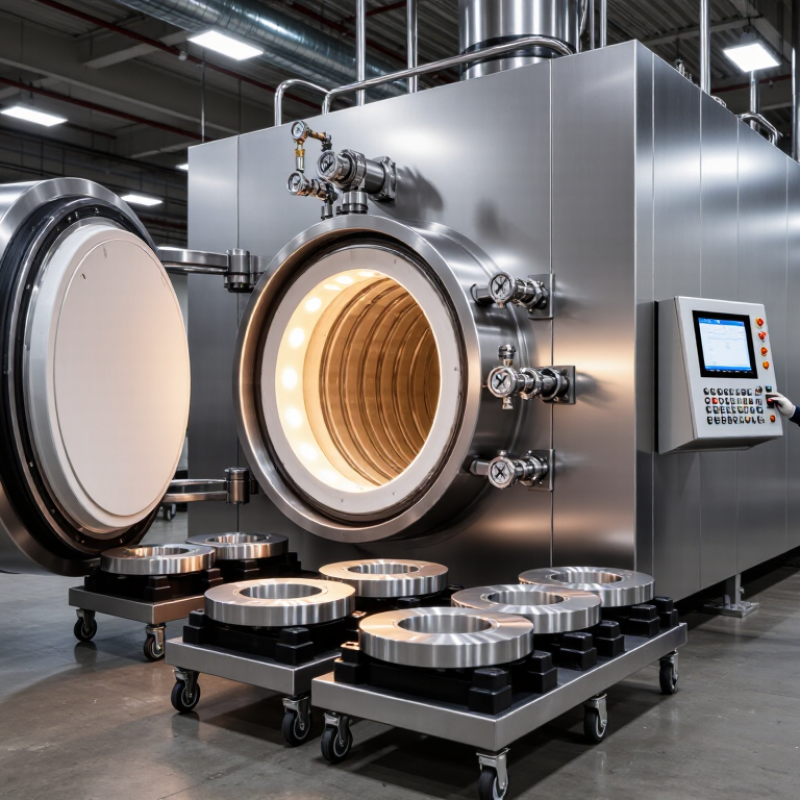
Choosing a vacuum furnace starts with the part, not the furnace shell. Define the alloy, section thickness, batch mass, hardness target, and distortion limit. A thin tool insert may need rapid gas quenching. A heavy die needs controlled cooling. Record pumping, heating, soaking, quenching, and cooling times. The details matter. The U.S. Department of Energy’s Industrial Decarbonization Roadmap (2022) identifies process heating as 51% of manufacturing energy use. Therefore, insulation, idle power, and cycle utilization deserve careful attention.
Vacuum level alone is not a complete specification. Ask about operating pressure, leak rate, partial-pressure control, temperature uniformity, and load thermocouples. AMS2750H provides useful guidance for pyrometry, system accuracy tests, and temperature uniformity surveys. Match the required class to product risk, not marketing language. The IEA’s Energy Technology Perspectives 2024 reports that industry consumes nearly 40% of global final energy. Efficient cycles are important, but repeatable cycles matter more.
Check service access under real heat and dust conditions. Request TUS maps, SAT results, vacuum traces, and representative metallography. Calculate throughput from usable load space, not chamber volume. Plant reviews often reveal optimistic assumptions. Perfect loading is rarely available. Leave capacity for qualification runs, maintenance, and one failed cycle. Measure twice.

Tip 1: Match the furnace type to the material and atmosphere. Vacuum furnaces reduce oxidation, but they need suitable pumping capacity and clean loading practices. ASM Handbook, Volume 4A, links vacuum processing with improved surface protection during heat treatment. The wrong atmosphere still causes trouble. Residual oil, moisture, or cutting fluid can contaminate the chamber. Inspect the load before every cycle.
Tip 2: Calculate usable hot-zone size, not chamber volume. Leave space around baskets, fixtures, and cooling channels. A crowded 600-millimeter load may heat less evenly than a smaller 500-millimeter load. The U.S. Department of Energy’s 2022 Industrial Decarbonization Roadmap identifies process heating as about 51% of manufacturing energy use. Better loading can reduce wasted energy and repeated cycles. This is often overlooked.
Tip 3: Choose working temperature from the complete recipe. Consider heating rate, soaking time, quenching speed, and cooling limits. A furnace rated at 1,300°C may perform poorly at 1,050°C if its control system is unstable. Follow AMS2750H principles for temperature measurement and uniformity surveys. Verify cold and hot zones with calibrated sensors.
Tip 4: Challenge the supplier’s capacity claims. Ask for test data using your actual alloy, fixtures, and batch weight. Laboratory results can look perfect. Production loads are less forgiving. Keep a margin below the maximum rating, but avoid buying excessive capacity. I would reconsider any decision based only on peak temperature. Energy use, maintenance access, and cycle repeatability matter just as much.
7 Tips for Choosing Vacuum Furnace Heat Treatment Equipment
Comparing Heating Systems, Vacuum Levels, and Atmosphere Control
Choosing vacuum furnace equipment starts with heating uniformity, not maximum temperature. Resistance heating offers predictable control for repeatable batches. Induction heating responds quickly, but complex loads may develop hot spots. Graphite elements tolerate extreme temperatures and reduce maintenance costs. Molybdenum supports cleaner processing, yet it reacts poorly to oxygen leaks. According to the U.S. Department of Energy’s 2022 Manufacturing Energy and Carbon Footprints report, process heating uses about 51% of manufacturing energy. Insulation, loading, and ramp control therefore affect operating cost. Not just specifications.
Vacuum readings need context. A chamber reaching 10⁻³ mbar may still contain moisture or virtual leaks. Many bright-metal processes use 10⁻⁴ to 10⁻⁵ mbar before gas backfilling. However, material sensitivity and temperature change that requirement. Gauge location also matters. A reading near the pump may not represent the work zone. ISO 20485 leak-testing guidance supports checking the complete system, not only the chamber door.
Atmosphere control separates reliable equipment from expensive guesswork. Use calibrated oxygen sensors, dew-point monitoring, and mass-flow controllers. Argon or nitrogen backfilling can improve cooling consistency, while partial-pressure control may reduce evaporation. The atmosphere should match the alloy, binder, and surface requirement. A common mistake is selecting a deeper vacuum than the process needs. That increases pump-down time and energy use. I would also challenge perfect-looking trial data; one successful batch proves very little. Door seals, dirty fixtures, and changing load weight often expose the real weakness.
| Tip | Decision Dimension | Common Options | Typical Technical Range | Main Advantages | Key Considerations | Suitable Applications |
|---|---|---|---|---|---|---|
| 1 | Match the heating system to the process temperature | Graphite resistance heating Metallic resistance heating using molybdenum or similar high-temperature alloys Induction heating | Graphite systems commonly support processes up to approximately 2,000–2,500 °C, depending on furnace design and atmosphere. Metallic heating systems are commonly used below approximately 1,800–2,000 °C. Induction heating is generally selected for electrically conductive loads and localized or rapid heating. | Graphite provides high-temperature capability and good energy efficiency. Metallic heaters can offer a cleaner process environment for selected applications. Induction can provide fast heat transfer and direct heating of conductive workpieces. | Check the interaction between the heater, workpiece, insulation, and atmosphere. Graphite may introduce carbon contamination in unsuitable processes, while metallic heaters have lower maximum-temperature limits. | Sintering, brazing, annealing, stress relieving, hardening, and high-temperature materials processing. |
| 2 | Select the vacuum level according to material sensitivity | Rough vacuum Medium vacuum High vacuum | Rough vacuum: approximately 1,000–1 mbar. Medium vacuum: approximately 1–0.001 mbar. High vacuum: approximately 0.001–0.000001 mbar, depending on chamber size, seals, pumping speed, and outgassing. | Lower pressure reduces oxygen, moisture, and other reactive gases. Higher vacuum levels can improve protection against oxidation and support cleaner surfaces. | A deeper vacuum is not automatically better. Consider the material’s vapor pressure, furnace leakage rate, load outgassing, required surface quality, and total pump-down time. | High-vacuum processing is useful for reactive metals, high-cleanliness parts, and processes where oxidation must be minimized. |
| 3 | Evaluate atmosphere control and gas purity | High vacuum Partial-pressure inert gas Full-flow inert gas Reactive or carburizing gas, where technically appropriate | Common inert gases include argon, nitrogen, and helium. High-purity process gases are often specified at 99.999% purity or higher when contamination control is critical. | Controlled atmospheres help limit oxidation, decarburization, nitriding, and unwanted chemical reactions. Gas selection can also improve heat transfer during cooling. | Specify gas purity, dew point, oxygen content, mass-flow control, pressure regulation, and exhaust safety. Nitrogen is not suitable for every reactive metal or high-temperature process. | Stainless steels, tool steels, nickel alloys, titanium-related processes, brazing, and applications requiring controlled surface chemistry. |
| 4 | Compare cooling performance, not only heating performance | Natural vacuum cooling Gas quenching High-pressure gas quenching Oil or liquid-assisted systems in specialized equipment | Gas-quench pressures commonly range from approximately 1 to 20 bar absolute, with some specialized systems operating at higher pressures. Actual cooling rates depend on gas type, flow path, pressure, load density, and fan performance. | Gas cooling can provide cleaner parts than liquid quenching and can reduce distortion or cracking when the cooling cycle is properly controlled. | Higher gas pressure does not guarantee uniform cooling. Confirm cooling-rate data, temperature uniformity, load limitations, fan capacity, and quench safety for the actual workload. | Hardening of steels and superalloys, solution treatment, aging, and processes requiring repeatable cooling rates. |
| 5 | Check temperature uniformity and control accuracy | Single-zone control Multi-zone control Multiple thermocouples and load monitoring | Many industrial vacuum furnaces are designed for working-zone uniformity around ±5 °C to ±10 °C, although the achievable result depends on temperature, load arrangement, furnace size, and qualification requirements. | Multi-zone control can compensate for thermal losses and improve temperature consistency across large or dense loads. | Review the furnace’s actual temperature-uniformity survey results rather than relying only on the controller’s display accuracy. Confirm sensor type, sensor placement, calibration intervals, and acceptable process tolerances. | Aerospace, medical, precision tooling, and any process with narrow metallurgical or dimensional tolerances. |
| 6 | Size the chamber for the real production load | Batch chamber Multi-chamber or modular system Horizontal or vertical loading configuration | Select the working zone based on usable dimensions, not external furnace dimensions. Allow sufficient clearance for gas circulation, thermal expansion, fixtures, and uniform heating. | Correct sizing improves productivity, energy efficiency, cycle repeatability, and cooling uniformity. | Avoid both overloading and routinely running an oversized empty chamber. Consider maximum load mass, fixture mass, part spacing, loading method, door clearance, and future production growth. | Batch production, laboratory development, contract heat treatment, and mixed-size component processing. |
| 7 | Verify measurement, automation, and maintenance features | Recipe-based control Data logging and electronic records Vacuum gauges and leak testing Preventive-maintenance access | Useful monitoring may include thermocouples, pressure gauges, residual-gas monitoring, gas-flow meters, cooling-pressure sensors, and alarm functions. Leak rate requirements should be defined for the specific process and chamber. | Automated recipes and recorded process data improve repeatability, traceability, troubleshooting, and quality-system compliance. | Confirm calibration capability, data-export formats, access control, alarm history, spare-part availability, pump maintenance requirements, door-seal replacement, and insulation service life. | Regulated manufacturing, repeat production, process qualification, failure analysis, and operations requiring documented batch records. |
Choosing Vacuum Furnace Heat Treatment Equipment
Choosing vacuum furnace equipment starts with temperature accuracy, not brochure maximums. Ask for calibration records and a recent uniformity survey. A displayed 1,100°C means little if the load center runs 12°C cooler. Place test thermocouples near corners, the center, and dense parts. Compare readings across a complete heating and cooling cycle. Small differences matter. For tool steel, uneven temperature can cause distortion, soft spots, or unexpected rework.
Energy use deserves a practical test. Request kWh data for a representative load, including pump-down, heating, holding, and cooling. An empty-chamber figure is rarely useful. Check insulation condition, door sealing, pump efficiency, and cooling-water demand. Faster heating is not always cheaper. Aggressive ramps may increase stress and maintenance. I once focused too heavily on cycle time and overlooked standby consumption. That was a costly oversight. Compare energy per treated kilogram, not per cycle alone.
Automation should protect the process, not merely add screens. Look for recipe control, password permissions, interlocks, alarm history, automatic leak checks, and trend exports. The system should pause safely when pressure or temperature leaves its permitted range. Operators need clear prompts and manual recovery options. Test these functions with a simulated fault before purchase. Ask whether software changes are logged and whether data remains accessible years later. No system removes human judgment. A good furnace makes that judgment easier to verify.
Temperature accuracy, energy use, and process automation should be evaluated together. The chart shows the maximum temperature uniformity ranges defined for furnace classes in AMS2750; a smaller value indicates tighter uniformity.
Reference: AMS2750 furnace temperature uniformity classes. Actual energy consumption and process capability depend on furnace design, load mass, insulation, cycle profile, vacuum level, and operating practices.
A safe vacuum furnace should make hazards visible before they become emergencies. Check door interlocks, pressure alarms, cooling-water sensors, and automatic power isolation. Ask how the system responds to a failed thermocouple. Test records matter more than attractive specifications. During a factory inspection, I would request a live alarm demonstration, not a verbal promise.
Maintenance needs are easy to underestimate.
Inspect the pump layout, filter access, heating elements, and gasket condition. Components should be reachable without dismantling half the chamber. Ask for cleaning intervals, spare-part availability, and calibration procedures. Keep a log with dates, temperatures, vacuum levels, and unusual sounds. A quiet pump is not always a healthy pump. I once trusted a simple maintenance schedule too much; dust around a seal later caused unstable pressure.
Supplier support should continue after installation.
Confirm technician response times, remote troubleshooting options, training materials, and service coverage. Request sample inspection reports and clear warranty conditions. Reliable suppliers explain limitations instead of promising perfect results. Ask whether they can help investigate uneven hardness or surface discoloration. Support quality often appears during a small problem, such as a delayed cooling cycle. One weakness remains easy to miss: operators may receive training, but new staff may not. Schedule refresher sessions and keep operating instructions beside the control panel.

