






Choosing an Automated Injection Molding supplier is more than comparing machine sizes or hourly rates. The right partner should prove how its equipment, people, software, and quality systems work together. Look for documented process validation, trained technicians, robotic part removal, real-time monitoring, and clear maintenance records. Ask to see sample production data, not only polished presentation slides. Details matter.
John Bozzelli, founder of Injection Mold Consulting, has stated, “You cannot mold quality into a part; quality must be designed into the process.” This principle should guide every supplier discussion. A reliable manufacturer will explain mold-flow analysis, resin drying, cavity balance, inspection methods, and traceability in practical terms. It should also describe what happens when a sensor fails or a cycle drifts overnight. Machines are not enough.
This guide presents ten practical tips for evaluating an Automated Injection Molding supplier. It considers technical capability, automation experience, material knowledge, quality control, scalability, communication, delivery performance, sustainability, and total cost. A supplier may look impressive and still lack disciplined follow-through. That risk is easy to overlook. Ask harder questions.
The strongest supplier will welcome factory visits, provide measurable examples, and admit where improvement remains necessary. No checklist is perfect. Your application may expose weaknesses that a standard audit misses. Therefore, compare evidence, not promises. Examine finished parts under real lighting, review defect records, and discuss a small pilot run before committing to long-term production. This careful approach can reduce rework, protect consistency, and create a partnership built on verifiable performance.
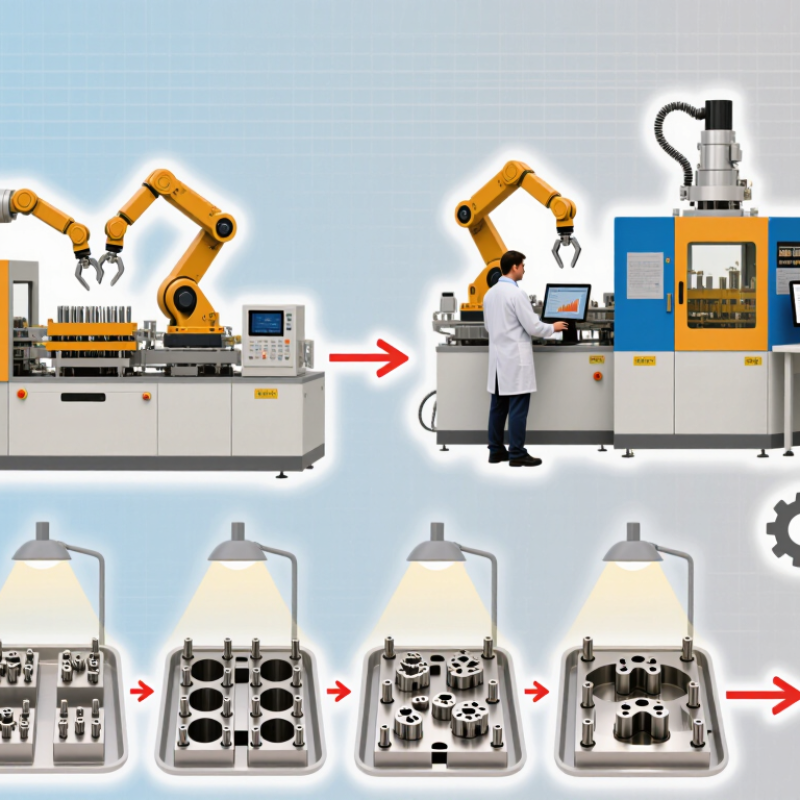
When choosing an automated injection molding supplier, define the part requirements before reviewing equipment. A tolerance target of ±0.01 mm demands more than a modern machine. It requires stable molds, controlled temperatures, accurate measurement, and disciplined process records. Ask how the supplier measures critical dimensions. A calibrated coordinate measuring machine can verify features, but sampling plans matter too. Measuring one perfect part proves very little.
Shrinkage, warpage, and cooling rates can change the final result. Request a capability study using production-intent tooling and material. The supplier should report Cp and Cpk values, not only promise tight tolerances. Discuss datum references, measurement uncertainty, and inspection frequency. A tolerance this tight may also be unnecessary for every feature. I would challenge it.
Material grades deserve equal attention. Specify the exact resin grade, reinforcement percentage, color, and required performance. For example, glass-filled engineering plastics can improve stiffness but may increase warpage and tool wear. Moisture-sensitive materials need documented drying temperatures and times. Ask for certificates, lot traceability, and retained samples. The supplier should explain how recycled content, pigment, or resin substitutions are controlled. Small changes can affect shrinkage and fit. Review the first-article report against the drawing, then test parts under real assembly conditions. Laboratory results alone can mislead.
| No. | Supplier Evaluation Tip | Recommended Part Requirement | Practical Target or Reference | How to Verify |
|---|---|---|---|---|
| 1 | Confirm critical dimensions | Identify functional dimensions, datum features, hole locations, and sealing surfaces before requesting a quotation. | Apply ±0.01 mm only to clearly defined critical features; use wider tolerances for non-functional dimensions where possible. | Review a dimensioned 2D drawing and GD&T scheme with the supplier before tooling begins. |
| 2 | Check tolerance capability | Require evidence that the automated molding process can repeatedly hold the specified tolerance. | For a ±0.01 mm target, request capability data such as Cpk ≥ 1.33 when statistically justified and agreed in advance. | Review capability studies, control charts, first-article results, and measurement-system analysis. |
| 3 | Match material grade to function | Specify the polymer family, reinforcement, colorant requirements, flame rating, and applicable regulatory requirements. | Use an exact generic grade description, such as unfilled PC, 30% glass-filled PA66, or acetal copolymer, rather than only “engineering plastic.” | Request the material technical data sheet, certificate of analysis, lot traceability, and identification of regrind content. |
| 4 | Evaluate shrinkage and warpage control | Consider material shrinkage, fiber orientation, wall-thickness changes, cooling balance, and gate location. | Typical linear molding shrinkage may range from approximately 0.5% to 2.0%, depending on polymer, grade, flow direction, and processing conditions. | Review mold-flow analysis, dimensional study results, and inspection data from parts produced after conditioning. |
| 5 | Verify drying and moisture control | Require controlled drying for hygroscopic materials and documented resin-handling procedures. | PA, PC, PBT, PET, and PEEK commonly require pre-drying; the exact temperature, time, and moisture limit must follow the material supplier’s data sheet. | Check dryer records, dew-point readings, material exposure time, and moisture test results where applicable. |
| 6 | Assess machine and mold precision | Confirm that the machine, mold base, cavity inserts, slides, ejectors, and temperature-control system are suitable for the tolerance target. | For ±0.01 mm features, prioritize stable process control, precision mold components, consistent cooling, and minimal cavity-to-cavity variation. | Review machine calibration, mold-maintenance records, cavity balance, and dimensional results by cavity. |
| 7 | Define inspection equipment | Specify the measurement method, resolution, environmental conditions, and inspection frequency for critical dimensions. | Use calibrated CMM, optical measurement, or suitable gauges; measurement resolution should be sufficiently finer than the ±0.01 mm tolerance. | Request calibration certificates and a gauge repeatability and reproducibility study for critical measurements. |
| 8 | Set process-validation requirements | Require documented approval of molding parameters, first articles, and production samples before release. | Validate fill, pack, hold, cooling, mold temperature, barrel temperature, cycle time, and part-conditioning requirements. | Review process-validation reports and confirm that approved parameters are protected from unauthorized changes. |
| 9 | Control appearance and defects | Define acceptable limits for flash, sink marks, weld lines, flow marks, burn marks, short shots, and color variation. | Use approved visual standards, defect samples, lighting conditions, viewing distance, and inspection time. | Approve boundary samples and include cosmetic criteria in the purchase specification. |
| 10 | Review production traceability | Require traceability from finished parts to resin lot, mold cavity, machine, production date, and inspection results. | Define retention periods, sampling plans, nonconformance procedures, and change-notification requirements. | Audit batch records, barcode or lot systems, inspection reports, and corrective-action documentation. |
| Generic Material Grade | Typical Characteristics | Common Applications | Key Supplier Checks |
|---|---|---|---|
| ABS, unfilled | Good impact resistance, dimensional stability, and surface finish; continuous-use temperature is generally lower than that of engineering polymers. | Housings, covers, interior components, and general-purpose functional parts. | Confirm impact grade, heat-resistance requirement, color stability, and allowable regrind. |
| Polycarbonate, unfilled | High impact strength and good dimensional performance; sensitive to moisture and processing conditions. | Transparent covers, safety components, electrical housings, and impact-resistant parts. | Verify optical requirements, drying controls, residual stress limits, and flame classification if required. |
| Polypropylene, unfilled | Low density, good chemical resistance, and fatigue resistance; relatively high shrinkage can affect precision dimensions. | Living hinges, containers, automotive components, and chemical-resistant parts. | Confirm melt-flow range, shrinkage assumptions, hinge-life requirement, and warpage controls. |
| Acetal copolymer, unfilled | Low friction, good wear resistance, stiffness, and dimensional stability; suitable for precision mechanical components. | Gears, bushings, clips, valves, and sliding or snap-fit components. | Check grade type, friction and wear requirements, gate location, and molding-temperature control. |
| PA66, 30% glass-filled | High stiffness and strength with anisotropic shrinkage caused by glass-fiber orientation; moisture absorption affects dimensions and properties. | Structural brackets, under-hood components, housings, and load-bearing parts. | Specify fiber content, conditioning state, moisture limits, fiber orientation considerations, and dimensional acceptance condition. |
| PEEK, unfilled | High-temperature capability, chemical resistance, and strong mechanical performance; requires specialized high-temperature processing equipment. | Aerospace, medical, semiconductor, chemical, and high-temperature precision components. | Verify processing-temperature capability, drying procedure, lot certification, crystallinity control, and post-molding conditioning. |
Note: Material properties, shrinkage, processing windows, and achievable tolerances vary by specific grade, part geometry, mold design, machine condition, measurement method, and environmental conditioning. Final specifications should be confirmed against the selected material supplier’s current technical data sheet and the approved part drawing.
