






A soup kettle may look like a simple countertop pot, but its job is more precise. It keeps prepared soup hot, smooth, and ready for service without constant stovetop attention. Many Soup Kettles use a thermostatically controlled water bath. Heat moves gently through the inner container, reducing scorching and uneven temperatures.
Foodservice consultant Darren Tristano offers a practical principle: “The best equipment protects consistency when staff attention is divided.” That idea fits soup kettles well. A busy café may fill the unit with tomato bisque at 11:30 a.m. By lunchtime, the surface should still look glossy, while the bottom should not taste burnt. The thermostat helps maintain steady heat. The water jacket softens direct contact with the heating element. A removable insert also makes portioning and cleaning easier.
That sounds simple. It is not.
The kettle’s performance depends on soup thickness, fill level, lid position, and stirring habits. A creamy chowder may need more frequent mixing than a thin broth. An underfilled kettle can lose heat quickly. An overfilled one may spill when the ladle moves. These small details are often ignored.
This guide explains what a soup kettle is, how its heating system works, and where its limits appear. It also considers temperature control, energy use, cleaning, and practical service routines. One point deserves reflection: a soup kettle holds food well, but it should not replace careful food handling or regular temperature checks. The machine assists judgment. It does not eliminate it.
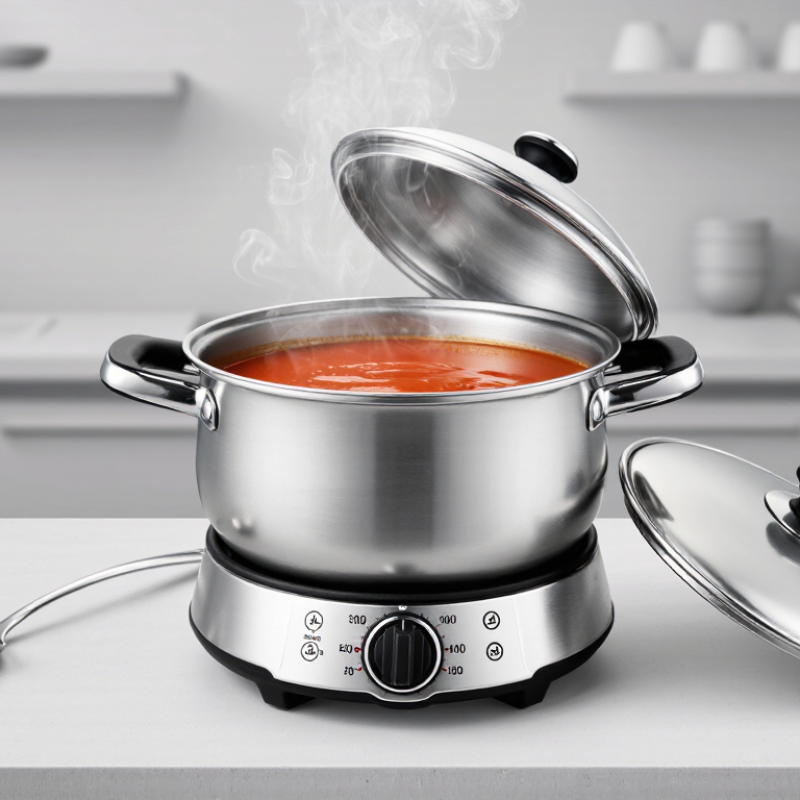
A soup kettle is a countertop food-holding appliance designed to keep prepared soup warm for serving. It usually contains a removable stainless-steel pot, an insulated outer basin, and an adjustable thermostat. Many models use a water bath, which surrounds the pot with gentle, even heat. This method reduces scorching and helps preserve texture better than direct heat.
A soup kettle is not usually intended to cook raw ingredients from the beginning. Its main purpose is temperature control, portion consistency, and efficient service during buffets, cafés, catered events, and institutional meals. The FDA Food Code recommends maintaining hot food at 135°F (57°C) or above, although operators must follow local requirements and workplace procedures. A thermometer remains essential because thermostat settings can be inaccurate.
The Food Waste Index Report 2024 estimated that over one billion tonnes of food were wasted in 2022. FAO also reported that 14% of food was lost between harvest and retail. These figures make controlled serving important, but a kettle cannot prevent waste by itself. Overfilling creates leftovers, while repeated reheating may damage flavor and texture. In practice, careful batch sizing, regular stirring, and documented temperature checks matter as much as the equipment.

A soup kettle is a compact bain-marie designed to keep prepared soup hot without exposing it to direct flame.
Its main components are simple but highly interdependent. An electric heating element warms the water jacket, while the water transfers gentle, even heat around the inner soup pan. This reduces scorching, especially in thick soups. The thermostat monitors temperature and cycles the heater on and off. It is the kettle’s control center.
The insulated outer shell limits heat loss and protects staff from hot surfaces. A removable pan supports faster cleaning, although narrow corners can still trap residue. The lid reduces evaporation and helps maintain serving temperature.
The control dial allows adjustment, but dial markings are not always precise. A calibrated probe is safer for verification.
The FDA Food Code 2022 requires hot-held food to remain at 135°F (57°C) or above.
That target should be checked inside the soup, not only on the kettle display.
The U.S. Environmental Protection Agency reports that restaurants can use five to seven times more energy per square foot than other commercial buildings, so insulation and thermostat accuracy matter.
In daily operation, overfilling the pan slows heating, while frequent lid opening causes avoidable temperature drops. Small habits matter. A kettle may appear stable while the soup surface cools unevenly. Monitoring, stirring, and recording temperatures remain necessary.
A soup kettle is designed to heat soup gently and keep it ready for serving. Unlike a cooking pot, it usually uses indirect heat. An electric element warms water around the inner container. This water bath spreads heat evenly and reduces scorching near the base.
A thermostat monitors the water temperature and controls the heating element. When the temperature drops, the element switches on. When it rises, the element pauses. The soup may stay warm for hours without vigorous boiling. However, temperature control is not always perfect. Opening the lid often can release heat quickly. Thick soup may also hold uneven temperatures, especially when it is not stirred.
Tips: Keep the lid closed between servings. Stir from the bottom every 20 to 30 minutes. Use a clean food thermometer to check the soup directly. For safer service, keep it consistently hot according to local food-safety guidance. Do not rely only on the kettle’s display. I have found that small temperature differences matter, particularly with creamy soups. Clean the inner container promptly after use. Dried soup can hide around seams and affect later heating.
What Is a Soup Kettle and How Does It Work?
A soup kettle heats and holds prepared food at a steady serving temperature. Most models use direct heat, a water bath, or a steam jacket. The vessel warms slowly, reducing scorching and preserving texture. The U.S. FDA Food Code 2022 recommends holding hot food at 135°F (57°C) or above. Temperature checks remain essential because a warm surface does not guarantee a safe center.
Different types suit different kitchens. Countertop water-bath kettles work well for cafés, buffets, and small catering stations. They heat gently and protect creamy soups from burning. Steam-jacketed kettles suit hospitals, schools, and high-volume kitchens. Steam surrounds the inner vessel, creating even heat for large batches. Direct-heated gas or electric kettles respond faster, but they demand closer stirring. Induction models offer precise control and a cooler work area. The choice is not always obvious. Batch size, cleaning access, ventilation, and service speed matter more than appearance. ENERGY STAR reports that restaurants can use five to seven times more energy per square foot than other commercial buildings, so insulation and efficient controls deserve attention.
Tips: Use a calibrated probe thermometer, not the display alone. Stir thick soup from the bottom every few minutes. Keep the lid closed between servings. Avoid overfilling; it slows reheating and makes spills more likely. A smaller kettle may perform better than a large one running half-empty.
| Soup Kettle Type | How It Works | Typical Temperature Range | Best Uses | Main Advantages | Important Considerations |
|---|---|---|---|---|---|
| Electric Water-Bath Soup Kettle | Electric heating elements warm a surrounding water bath. The hot water transfers gentle, even heat to the inner soup container. | Approximately 60–95°C (140–203°F), depending on the model and control setting. | Buffets, cafeterias, catered events, self-service stations, and front-of-house soup service. | Helps reduce scorching and maintains a consistent serving temperature without direct contact between the heating element and the soup. | The water level must be monitored. It is designed mainly for holding and serving prepared soup rather than rapidly cooking raw ingredients. |
| Dry-Heat Electric Soup Kettle | Heating elements warm the soup container directly or heat an insulated chamber around it without using a water bath. | Typically adjustable from about 60–95°C (140–203°F). | Small food-service counters, break rooms, tasting areas, and locations where adding water to a kettle is inconvenient. | Simple setup, reduced water handling, and convenient temperature adjustment. | Direct heat may create hot spots if the soup is thick or is not stirred periodically. The manufacturer’s operating instructions should be followed. |
| Bain-Marie Soup Kettle | The soup container sits in hot water, allowing indirect heat to surround the container and moderate temperature changes. | Generally maintained above 60°C (140°F) for hot holding when local food-safety rules require it. | Long service periods, buffets, banquet lines, sauces, gravies, and delicate cream-based soups. | Gentle, uniform heating helps protect texture and lowers the risk of burning compared with direct heating. | Water evaporation can reduce heating performance. The soup should be checked and stirred according to the service procedure. |
| Steam-Jacketed Kettle | Steam circulates through a jacket surrounding the cooking vessel. Heat is transferred evenly through the vessel wall. | Often operated around 85–120°C (185–248°F), depending on steam pressure and the cooking process. | Large-volume production of soups, stews, stocks, sauces, and other liquid or semi-liquid foods. | Efficient batch cooking, even heat distribution, and good capacity for institutional or commercial kitchens. | Requires a suitable steam source or integrated steam system. It needs more space, maintenance, and operator training than countertop units. |
| Insulated Manual Soup Kettle | Uses an insulated container and lid to slow heat loss. It does not actively generate heat unless paired with a separate heating system. | Depends on the starting temperature and insulation quality; it is intended for short-term hot or cold holding. | Transport, outdoor catering, temporary serving points, and situations without access to electricity. | Portable, quiet, energy-free during use, and useful for moving prepared soup safely over short periods. | It cannot restore lost heat. Soup should be loaded at a safe temperature and monitored under the applicable food-safety procedures. |
| Induction-Compatible Soup Kettle | An induction cooktop creates a magnetic field that heats a compatible metal vessel directly, allowing precise external control. | Typically adjustable from low holding heat to near-boiling temperatures, depending on the induction unit and vessel. | Open kitchens, mobile food service, cooking demonstrations, and operations needing flexible heating equipment. | Fast response, efficient heat transfer, and no exposed heating element on the cooking surface. | Only magnetic cookware is compatible. The vessel base must remain suitable for induction, and stirring may be needed to prevent uneven heating in thick soups. |
| Countertop Soup Warmer | A compact electric unit heats a removable insert or pot, usually through direct heat or a water bath, to keep prepared soup ready for service. | Commonly designed for hot holding at approximately 60–95°C (140–203°F). | Restaurants, cafés, convenience food areas, offices, and low-to-medium-volume service. | Compact footprint, easy access, and straightforward operation for one or more soup varieties. | Capacity is usually smaller than that of production kettles. It is generally not intended for cooking large quantities from raw ingredients. |
| Tilt Soup Kettle | The heated vessel pivots or tilts so the operator can transfer thick soup, stock, or sauce into containers without lifting the entire kettle. | Varies by heating system; many models support controlled cooking and hot holding temperatures. | Central kitchens, hospitals, schools, catering operations, and high-volume batch production. | Improves portioning and discharge efficiency, especially when handling heavy or viscous foods. | Requires adequate clearance for tilting. Operators must use care around hot liquid, steam, and the moving vessel. |
A soup kettle heats soup indirectly. An electric element warms a water jacket, while a thermostat maintains serving temperature. This gentle bath reduces scorching, but it does not make food sterile. Safety comes first. The FDA Food Code 2022 sets 135°F (57°C) as the minimum hot-holding temperature for time/temperature control foods. Check the soup with a calibrated probe, not only the display. Stir periodically, especially near the bottom and sides. Record temperatures during service. Small gaps in logging can hide real problems.
Cleaning needs a deliberate routine. Turn off and unplug the kettle before handling it. Let hot surfaces cool, then remove the insert, lid, and ladle for washing and sanitizing. Never immerse an electrical base. Wipe the water jacket and rim with a clean, food-safe cloth. The CDC recommends washing hands for at least 20 seconds, which matters when refilling or changing utensils. A 2022 CDC report estimates that foodborne illness causes about 48 million illnesses annually in the United States, so casual cleaning is not harmless.
Routine maintenance is simple, but often neglected. Inspect the cord, plug, hinge, gasket, and thermostat each day. Look for cracked insulation, mineral scale, loose handles, or unusual cycling. Descale according to the equipment instructions; harsh chemicals may damage surfaces. NSF/ANSI 4 is commonly used for commercial cooking and food-holding equipment sanitation requirements. Keep a service log with dates and observations. I would not trust a kettle merely because it looks clean. Test temperature accuracy regularly, and replace damaged parts before service resumes.
These benchmarks reflect widely used FDA Food Code temperature controls: cold food at or below 5°C (41°F), hot-held soup at or above 57°C (135°F), and cooling from 57°C to 21°C (135°F to 70°F) within 2 hours before reaching 5°C (41°F) within 6 hours total. Verify local requirements and follow the kettle manufacturer’s cleaning and maintenance instructions.
Reference: FDA Food Code 2022. Temperatures shown in degrees Celsius.

