How to Choose No Tear Drawstring Garbage Bags
Choosing a No Tear Drawstring Garbage Bag starts with a practical question: what will it carry?
A kitchen bag may hold coffee grounds, wet packaging, and a cracked glass jar. An office bag faces lighter waste, but it may sit untouched for several days. These conditions expose weak seams, thin film, and poorly anchored drawstrings. The World Bank’s What a Waste 2.0 report estimated 2.01 billion tonnes of municipal solid waste worldwide in 2016. It projects 3.40 billion tonnes by 2050. The U.S. Environmental Protection Agency reported 292.4 million tons of municipal solid waste in 2018. Those figures show why reliable bag performance matters beyond household convenience.
A strong selection process should examine material thickness, puncture resistance, seam strength, stretch, and closure design. ASTM D1709 can help evaluate plastic film impact resistance. ASTM D882 measures tensile properties. These tests offer useful evidence, but they do not guarantee performance in every bin. A “no tear” label is not magic. It may describe controlled testing rather than a real bin filled with damp scraps and sharp carton edges. That distinction deserves attention.
This guide will compare bag capacity, gallon ratings, liner dimensions, drawstring construction, and leak resistance. It will also consider recycled content and responsible disposal claims. UNEP’s 2023 Turning off the Tap report emphasizes reducing unnecessary plastic use and improving circular systems. A thicker bag is not automatically the better choice. Sometimes, it only uses more material. The best No Tear Drawstring Garbage Bag matches the waste, the container, and the handling routine. Small details matter.
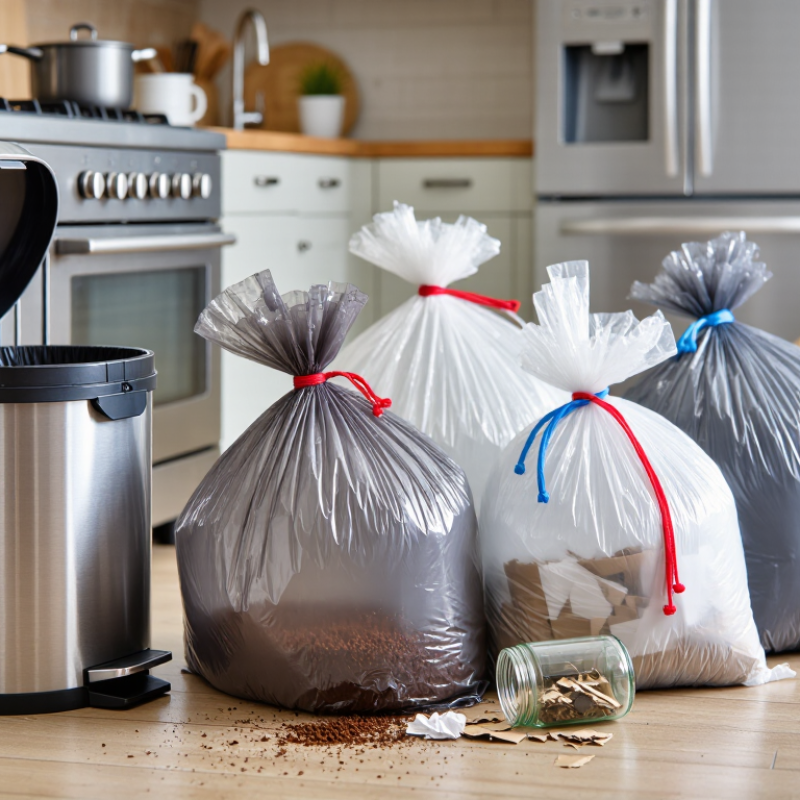
Understanding No-Tear Drawstring Garbage Bag Materials
Choosing no-tear drawstring garbage bags starts with the material, not the printed capacity. Most reliable options use linear low-density polyethylene, sometimes blended with high-density polyethylene. LLDPE stretches around rough edges, while HDPE adds stiffness and puncture resistance. During a simple home test, I filled bags with damp food scraps and empty cartons. Sharp corners still exposed weak seams. No plastic is truly tear-proof. That matters.
Film thickness should be judged alongside flexibility, seam strength, and puncture performance. A thicker film can still fail if the resin is brittle or poorly processed. Look for a continuous drawstring channel with reinforced edges. The cord should pull smoothly without separating the upper rim. Recycled content can reduce environmental impact, but its quality may vary. Reliable suppliers should provide consistent thickness data and independent impact or tensile testing, such as methods based on ASTM procedures.
For kitchen waste, flexible LLDPE usually handles wet contents and irregular shapes well. For heavier loads, a thicker blend with stronger seams may be more practical. I once selected bags by thickness alone, then watched one split near the knot. That small mistake changed my buying checklist. Softness, stretch, and odor resistance also influence daily use. Check the actual bag, not only the package description. A careful material choice makes the drawstring easier to close and reduces leaks during carrying.
Checking Bag Size, Capacity, and Thickness
Choosing no tear drawstring garbage bags starts with matching the bag to the bin, not the packaging label. Measure the bin’s height, opening width, and rim circumference. Add extra length for folding over the edge. A bag that barely reaches the rim may pull loose when filled. I once chose a tight fit for a small office bin, and the drawstring snapped during removal. That mistake was avoidable.
Capacity also depends on the waste itself. Lightweight paper can fill a bag quickly without creating much strain. Food scraps, damp tissues, and dense cleaning waste need more usable capacity. Leave space near the top for tying. An overfilled bag places pressure on the seams and drawstring holes. Check the stated capacity, but treat it as an estimate. Real household waste rarely behaves like a controlled test sample.
Thickness is equally important. Thin bags may suit dry, light waste, while thicker material offers better resistance against sharp corners and heavy moisture. However, thickness alone does not guarantee strength. Seam quality, film flexibility, and proper storage also matter. Look for even seams and a drawstring that moves smoothly without tearing the top edge. Hold the bag against a light source and inspect weak-looking areas. Small flaws can become large leaks. I still find thickness comparisons imperfect because manufacturers may measure it differently. That is why testing one bag with your usual waste is more reliable than trusting a single number.
Evaluating Drawstring Strength and Closure Design
A no-tear drawstring garbage bag should feel dependable before it carries a full load. In practical use, the drawstrings receive the most stress near the bag’s rim. Look for wide, evenly sealed attachment points. Thin or uneven seams may open when you pull the closure tightly. I have found that a strong bag can still fail when its drawstring channel is poorly formed.
Test the closure with a moderate load, not just an empty bag. Place bottles, food containers, or other household waste inside, then lift the bag slowly by both strings. The cords should tighten smoothly without cutting into the plastic. A rounded channel usually distributes pressure better than a narrow, sharp channel. The knot should stay secure, yet remain easy to release when the bag needs replacing.
Pay attention to cord length and balance. If one side is much longer, the opening may close unevenly and leave gaps. That weakness can cause spills during transport. Some closures feel firm at first but loosen after repeated pulling. This is worth checking. No test is perfect. Temperature, sharp packaging, and overfilling can change performance. For greater reliability, choose a bag with reinforced seams, flexible material, and clearly attached drawstrings. A practical evaluation should include both pulling strength and everyday handling, because laboratory-style performance does not always match a rushed kitchen cleanup.
Comparing Leak Resistance and Puncture Protection
How to Choose No Tear Drawstring Garbage Bags
Leak resistance and puncture protection are different performance tests. A bag can block liquid but still split when a sharp can edge presses against its wall.
ASTM D1709 measures impact resistance, while ASTM D2582 evaluates puncture propagation.
These standards help buyers compare material strength beyond vague claims like “heavy duty.”
In practical use, check the bottom seam first. It faces pooled liquid, food scraps, and sudden weight. A strong drawstring also matters because lifting concentrates force around the rim.
Thicker film often improves protection, but thickness alone can mislead. Poor sealing may create weak points. I have seen bags with firm sidewalls fail at the seam after one sharp object shifted inside. Small details matter.
The OECD Global Plastics Outlook reported 353 million tonnes of plastic waste in 2019, with only 9% recycled. This makes material efficiency important, not just bag toughness.
The UNEP report Turning off the Tap estimates that plastic pollution could be reduced by 80% by 2040 through better design and reuse.
For household waste, choose the lightest bag that passes your real test: fill it with wet scraps, add a blunt-edged container, and lift it slowly. Test again with corners exposed. The result may challenge the label. That is useful.
Selecting the Right Bag for Different Household Waste Types
How to Choose No Tear Drawstring Garbage Bags
Selecting the Right Bag for Different Household Waste Types
Choosing a garbage bag starts with the waste, not the color or package size. Food scraps need strong, leak-resistant bags with sealed seams. A bag that survives dry waste may fail under wet vegetable peels. Check the thickness and stated capacity before filling it.
For bathroom waste, a smaller drawstring bag usually works best. It reduces overloading and makes daily removal easier. Pet litter needs extra strength because its weight gathers at the bottom. Use a reinforced bag and avoid dragging it across rough floors. Sharp packaging, such as broken plastic edges, should be wrapped before disposal. Even a thick bag can tear at one weak point.
Dry household waste, including paper and empty containers, needs less puncture resistance. However, oversized bags often become awkward and difficult to tie. Leave several inches of space above the waste. Pull the drawstrings gently, then lift from the tied area and the bag’s base. In my experience, this simple habit prevents many spills. I still sometimes choose a bag that is too large. That wastes material and makes carrying less stable. Local waste collection guidance should also influence your choice, especially for recycling and food-waste separation. Some households may need separate bags rather than one heavy mixed load.
How to Choose No-Tear Drawstring Garbage Bags
Recommended bag volume for different household waste types
Food scraps and pet litter are dense, so smaller reinforced bags are easier to lift safely. Dry recyclables and yard waste usually need larger bags because they are bulky but relatively light. Choose a no-tear drawstring bag with extra thickness and avoid filling any bag beyond about 80% of its volume.