






Choosing Material Handling Robots is less about buying the newest machine and more about matching a robot to the work on your floor. Joseph F. Engelberger, a robotics pioneer, is widely credited with saying, “I can’t define a robot, but I know one when I see one.” For warehouse teams, the practical question is more specific: can the system move your actual loads, through your actual space, at the pace your operation needs?
Start with the task. A pallet-moving AMR, a fixed industrial arm, and an autonomous forklift solve different problems. Record load weight, dimensions, pickup height, travel distance, aisle width, and daily peaks. Watch the route during a busy shift. A clear floor plan can still hide a blocked fire door or a slippery corner. Small details matter.
Then compare safety features, navigation, integration, service support, and total cost over time. Ask vendors to demonstrate your own containers and workflows, not only a polished test setup. Check how the robot behaves when a pallet is crooked or a route is temporarily blocked. It may pause. That matters. A pilot can expose downtime, training needs, and awkward handoffs before a larger rollout. Be honest about the data, too; cycle-time estimates are often less tidy than expected. The best choice is not always the fastest robot. It is the one your people can use reliably, maintain, and adapt as demand changes.
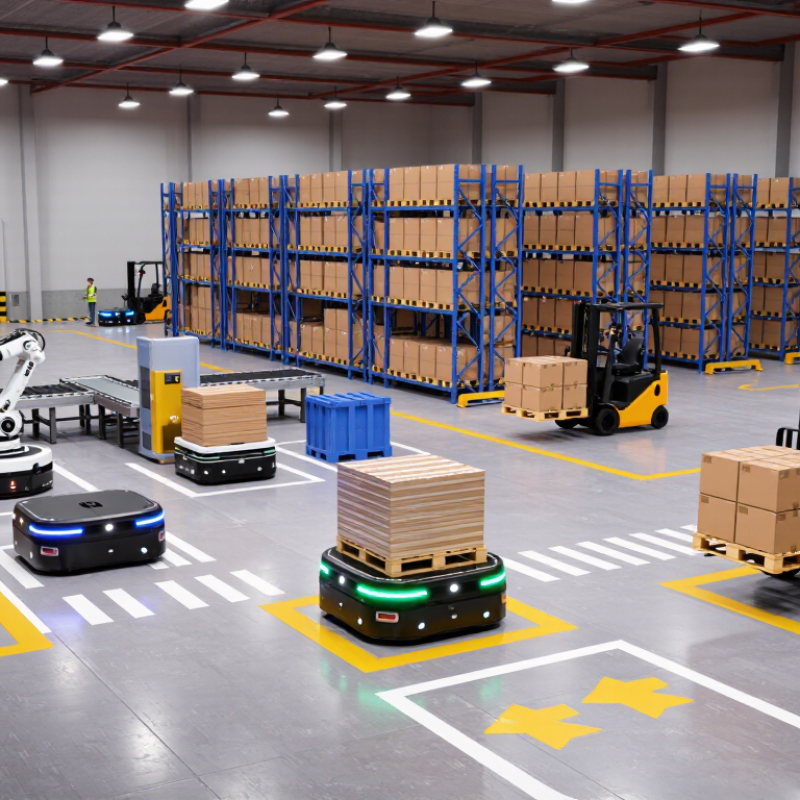
Start by mapping each movement the robot must handle: where loads begin, where they go, and how often trips occur. Record load dimensions, weight, packaging, and the heaviest realistic case—not just the average carton. A pallet that shifts slightly on a rough floor can change the handling requirements. Small details matter.
Measure aisle widths, turning spaces, floor transitions, and docking points on site. Note pedestrian crossings, doorways, and shared work areas during busy shifts. Then estimate required moves per hour, peak periods, and acceptable downtime. If orders vary by season, use real operating data where possible. Guesswork can make a neat plan look more certain than it is.
Check how the robot will connect with conveyors, lifts, storage systems, and existing work procedures. Confirm where charging can happen without blocking traffic, and who will clear a stalled load. Measure it twice. Requirements often change once teams see a route in motion, so trial runs should include awkward loads and congested periods. A requirement that seems minor on paper may become a daily bottleneck. Be willing to revise the plan.

Material handling is not one job. A mobile robot can move a tote across a changing work area, while an automated guided vehicle follows a more fixed route. For pallet loads, an autonomous forklift may reduce repeated driving; a robotic arm suits repeatable picking, packing, or machine tending. Check payload, travel distance, aisle width, floor condition, and handoff points before comparing models. A robot that handles the load but cannot turn at the rack is the wrong fit.
The International Federation of Robotics reported 4,281,585 industrial robots operating worldwide in 2023, with 541,302 installed that year (World Robotics 2024). These figures show broad automation adoption, but they do not tell you which robot type fits a specific warehouse. Run a small pilot using real shift patterns and representative loads. Measure cycle time, blocked routes, mispicks, and recovery time after a stoppage. One awkward handoff can undo a tidy simulation. It happens.
Tips: Match the robot to the task, not the trend. Mark routes with tape, test peak-hour traffic, and ask operators where loads snag. Compare safety features, integration needs, maintenance access, and total cost over the expected service life. Leave room for human judgment; the first layout rarely stays perfect.
| Robot type | Best suited tasks | How it moves or works | Payload suitability | Key advantages | Main considerations |
|---|---|---|---|---|---|
| Autonomous mobile robot (AMR) | Moving totes, components, carts, or other loads between workstations, storage, and packing areas. | Navigates using onboard sensors and mapping; can typically plan or adjust routes around obstacles. | Varies by model and platform; available solutions range from small-item carriers to heavy-load units. | Flexible routes; useful in changing layouts; can reduce repetitive transport work. | Needs suitable routes, traffic management, charging arrangements, and integration with doors, lifts, or workflow systems where applicable. |
| Automated guided vehicle (AGV) | Repeatable transport along established routes, such as moving pallets or production materials between fixed points. | Follows defined guidance or navigation infrastructure; route changes may require system updates or facility changes. | Available in configurations for light loads through heavy pallet and industrial loads. | Well suited to stable, repetitive transport flows and predictable routes. | Less adaptable than many AMR systems when routes or workflows change; assess aisle access and interaction with people and vehicles. |
| Articulated industrial robot | Machine tending, case packing, palletizing, depalletizing, and handling parts across a work cell. | A multi-joint arm moves an end-of-arm tool through a programmed work envelope. | Broad range, from small-part handling to heavy industrial loads; capacity depends on arm reach and configuration. | Flexible reach and motion; can perform repeated handling tasks at high production rates when properly engineered. | Requires application-specific tooling, programming, risk assessment, and appropriate safeguarding or safety-rated design. |
| Collaborative robot (cobot) | Light- to medium-duty pick-and-place, kitting, packaging, and machine tending where workers share a workspace under a validated safety setup. | A compact robotic arm designed with features that can support collaborative applications; the complete work cell must still be risk-assessed. | Generally selected for lighter loads than many large industrial arms; verify payload, reach, and tool weight for the application. | Often compact and comparatively straightforward to redeploy between suitable tasks. | Collaborative capability does not automatically make every application safe without guarding; speed and payload may be limited by the task and safety requirements. |
| Cartesian or gantry robot | Palletizing, case handling, loading and unloading, and movement over a large, rectangular work area. | Moves along linear axes, commonly in a straight-line X-Y-Z arrangement, often above or around the work area. | Can be configured for a wide range of loads, depending on the structure, axes, and end effector. | Provides predictable straight-line motion and can cover broad areas with a fixed installation. | Requires space for the frame and travel; less suited than an articulated arm to tasks needing complex approaches around obstacles. |
| Robotic forklift or pallet-handling vehicle | Transporting, staging, or storing palletized loads between docks, production areas, and warehouse locations. | A mobile vehicle with fork or load-handling equipment navigates facility routes and performs pallet pickup or placement. | Designed for palletized loads; check rated capacity, load dimensions, lift height, and load-center requirements. | Automates pallet movements without requiring a separate robot arm for each transfer point. | Needs compatible pallets, sufficient aisle and turning space, clear pickup locations, and safe coordination with people and other vehicles. |
| Robotic picking system with vision | Picking and sorting individual items from bins, totes, or conveyors for order fulfillment or production feeding. | Combines a robot, camera or other sensing, and software to identify item locations and guide the pick. | Usually selected for the item size and weight range in the application; irregular or fragile items may need specialized gripping. | Can handle varied item positions when the vision and grasping system is matched to the inventory. | Performance depends on item presentation, lighting, packaging, graspability, and the quality of vision-system training and integration. |
Selection note: Payload, reach, travel speed, throughput, and safety requirements vary by model and application. Confirm the rated specifications and evaluate the robot with representative loads, routes, and work conditions before deployment.
A material-handling robot must fit the building, not just the task list. Map aisle widths, turning points, floor joints, ramps, door clearances, and busy pedestrian crossings. A robot that clears a drawing may still struggle beside a pallet overhang. The International Federation of Robotics reported about 541,000 industrial robot installations worldwide in 2023 in its World Robotics 2024 report. That figure signals broad adoption, but it does not tell you whether a robot suits your floor. Measure the route.
Payload checks need more than the product’s stated weight. Include the pallet, container, gripper, and any load shift during acceleration or braking. Check the load’s center of gravity, too. A tall, uneven stack may be harder to move safely than a heavier, compact one. MHI’s 2024 Annual Industry Report found that 55% of respondents planned to increase investment in supply-chain innovation and technology. Investment is growing; careful site checks still matter.
System compatibility can make or break a deployment. Confirm how the robot exchanges task, location, and fault data with warehouse software, conveyors, lifts, and charging equipment. Ask who owns interface testing, and test real exception cases, such as a blocked aisle or a missing pallet. Small details matter. I would not assume that a successful route simulation proves the whole system is ready; actual traffic and shift changes can expose gaps. Keep time for a pilot, and revise the plan when operators find friction.
Compare the robot’s payload range with your heaviest load, then check aisle width, turning space, floor conditions, and pickup/drop-off points. Confirm the robot can integrate with your warehouse systems and safety equipment. Payload ranges are indicative; specifications vary by model.
A material handling robot should make a specific task safer, not simply move faster. Map the route, payload, pinch points, and people sharing the aisle. Then test emergency stops, protective sensors, and recovery procedures under realistic conditions. A safety demonstration is useful; a documented risk assessment is better. Reliability needs equal scrutiny. Ask for expected uptime, maintenance intervals, spare-part lead times, and service response targets. Request operating data from similar shifts, not only ideal factory trials. Small faults matter. A stalled lift can block a whole aisle.
Integration can make or break a project. Confirm that the robot can exchange orders and status updates with existing warehouse systems, and test what happens during network loss. The International Federation of Robotics reported 553,052 industrial robot installations worldwide in 2022, a 10% annual increase (World Robotics 2023). Adoption is growing, but scale alone does not prove suitability. Compare total cost: equipment, installation, software, training, energy, maintenance, and downtime. MHI’s 2024 Annual Industry Report found 55% of surveyed supply chain professionals planned to increase technology investment that year. Use that as context, not a reason to rush. A spreadsheet may understate awkward handoffs or uneven floors. Pilot the robot on a busy shift, record exceptions, and revise the assumptions.
A robot that looks capable in a showroom may struggle with your actual aisles, loads, or shift patterns. Test candidates in the work area they will serve. Use representative pallets, bins, and load weights, including awkward shapes your team handles every day. Watch how each robot turns at aisle ends and crosses floor joints. Small bumps can expose problems a smooth demo never reveals.
Keep the test realistic. Run repeated trips during a busy shift, then record cycle times, missed handoffs, operator interventions, and charging needs. Check whether the robot stops reliably when people enter its route. Ask maintenance staff to review access to batteries, sensors, and common service points. Count the support hours, too. A fast unit can become costly if it needs frequent attention.
Compare results against your actual priorities, not a single headline speed. One test plan may still miss a seasonal rush or an unusual load. That is worth admitting. Include operators in the review; they may spot awkward staging or unclear alerts before managers do. Confirm that the solution can connect with existing dispatch and inventory systems, and define who handles updates and troubleshooting. Choose the candidate that performs consistently under ordinary working conditions, not only during its best run.

