






Choosing a Pastry Maker supplier in China involves more than comparing prices. Global buyers must match machine capacity, product range, and production needs. A bakery producing delicate Danish pastries may need different forming tools from a plant making uniform cookies. Details matter. Line speed, dough handling, changeover time, and cleaning access can affect daily output.
This guide introduces ten Chinese suppliers for international buyers and outlines practical points for evaluating them. Compare machine specifications, customization options, spare-parts availability, and after-sales support. Ask for clear product videos, technical drawings, and references for similar installations. Check whether quoted capacities reflect real production conditions, not just ideal demonstrations. Documentation and certifications should also be reviewed against the requirements of your destination market.
A supplier profile is only a starting point. It cannot confirm build quality or service performance on its own. Request written answers, inspect sample products where possible, and clarify installation and warranty terms before placing an order. Some information may be difficult to compare directly; suppliers may use different testing methods or define capacity differently. That deserves a closer look. With careful verification, buyers can create a more reliable shortlist and choose equipment that fits their product, workforce, and production plan.
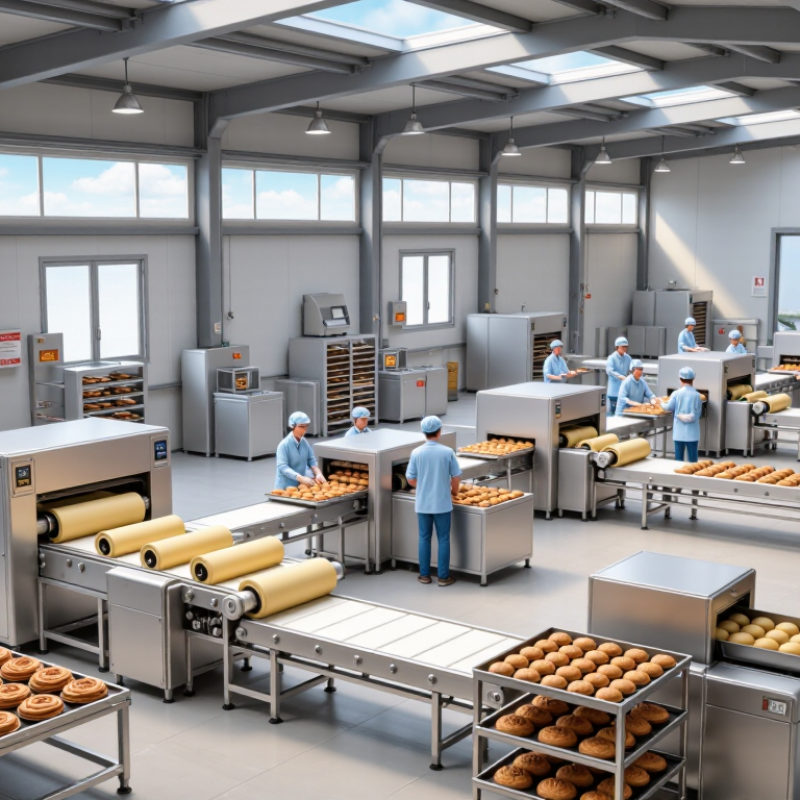
Understanding China’s Pastry Manufacturing Industry
China’s pastry industry combines large-scale ingredient sourcing with highly varied regional tastes. Frost & Sullivan’s market analysis estimated China’s bakery market at RMB 285.3 billion in 2021, and forecast RMB 351.8 billion by 2025. That figure covers bakery products broadly, not pastry suppliers alone. Buyers should treat it as market context, not a measure of any factory’s output.
Production details matter. A pastry line may handle laminated dough, filled buns, or frozen products, each requiring different temperature control and packaging. Ask suppliers for product-specific capacity, batch records, shelf-life test methods, and ingredient specifications. Check how they control dough temperature and humidity; small changes can affect layers, texture, and consistency. Frost matters. So does transit time. China’s scale can support flexible orders, but capacity claims need verification against equipment, staffing, and recent production records. A factory’s sample may not represent routine output. Request samples from regular production runs, and compare them after realistic storage and shipping conditions. Industry reports explain demand; factory-level evidence is still essential.
Buyer-oriented overview of ten common pastry manufacturing supplier categories in China. These are product and production profiles, not a ranked list of named companies; capabilities and certifications vary by facility.
| Supplier Category | Typical Products | Common Production Capabilities | Potential Buyer Fit | Checks Before Ordering |
|---|---|---|---|---|
| Mooncake manufacturers | Traditional baked mooncakes, flaky-style mooncakes, and filled seasonal pastries | Dough preparation, filling portioning, forming, baking, cooling, and individual or gift-box packing | Importers, retailers, and food-service buyers planning seasonal or Asian bakery ranges | Confirm recipe and filling specifications, allergen controls, shelf-life evidence, packaging suitability, and production schedule |
| Frozen laminated-dough producers | Puff pastry sheets, pastry blocks, tart shells, and croissant-style dough | Layered dough preparation, sheeting, portioning, freezing, and frozen distribution packing | Commercial bakeries and distributors with cold-chain storage and handling | Review storage and transport conditions, thawing and baking instructions, ingredient declarations, and test-bake results |
| Frozen ready-to-bake pastry makers | Frozen buns, danish-style pastries, filled pastries, and proof-and-bake products | Forming and filling, freezing, and packing products for later proofing or baking where specified | Retail bakeries, hotels, cafés, and food-service operators seeking convenient preparation | Clarify whether products are raw, proofed, par-baked, or fully baked, and validate preparation instructions at the destination |
| Chinese-style baked pastry producers | Flaky pastries, bean-filled pastries, egg-yolk pastries, and regional baked snacks | Pastry lamination, filling preparation, shaping, baking, and retail packing | Specialty food importers and retailers serving customers interested in Chinese bakery products | Check filling composition, ingredient translation, allergen declarations, breakage protection, and shelf-life substantiation |
| Shortcrust and tart-shell manufacturers | Tart shells, pie shells, pastry bases, and sweet or savory crusts | Dough mixing, rolling or pressing, shell forming, baking or freezing, and bulk or retail packing | Bakery ingredient distributors and manufacturers assembling desserts or ready-to-fill products | Specify dimensions, baked status, texture, moisture protection, and compatibility with intended fillings |
| Cookie and biscuit bakeries | Butter-style biscuits, filled cookies, crisp pastries, and assorted baked snacks | Mixing, depositing or cutting, baking, cooling, and moisture-protective packaging | Retailers, private-label buyers, and distributors seeking ambient packaged bakery products | Assess breakage rates in transit, packaging barrier properties, ingredient and allergen statements, and shelf-life data |
| Egg-tart and custard-pastry producers | Egg-tart shells, custard-filled pastries, and frozen or ready-to-bake tart products | Shell forming, custard preparation or filling, baking or freezing, and product-specific packing | Food-service buyers and bakeries able to manage any required refrigerated or frozen storage | Verify product state, cold-chain requirements, handling instructions, and applicable food-safety controls for egg and dairy ingredients |
| Steamed pastry and bun manufacturers | Steamed buns, filled buns, and other soft wheat-flour pastries | Dough mixing, fermentation, portioning, filling, steaming, and chilled or frozen packing | Asian grocery distributors and food-service businesses with suitable chilled or frozen logistics | Confirm storage conditions, reheating directions, packaging integrity, and the product’s validated shelf life |
| Pastry filling and component suppliers | Bean, fruit, custard-style, nut, and other bakery fillings or prepared components | Ingredient preparation, blending or cooking, portioning, and chilled, frozen, or ambient packing depending on product | Industrial bakeries and pastry makers sourcing components separately from finished products | Request full formulation and allergen information, ingredient specifications, microbiological criteria, and storage guidance |
| Private-label pastry manufacturers | Custom-branded pastries, assorted bakery snacks, and buyer-specified product ranges | Product development, specification-based production, packaging coordination, and export documentation support where available | Retail brands and importers seeking products made to their own recipe, format, or packaging brief | Agree on product specifications, artwork approval, ownership of custom formulations, sample sign-off, audit scope, and export-market compliance |
