China Top 10 Silicon Inductor Manufacturers in 2026?
China’s silicon inductor industry is entering 2026 with stronger demand from 5G equipment, electric vehicles, industrial controls, and compact consumer electronics. A Silicon Inductor can support high-frequency filtering while occupying limited board space. Its value becomes clearer inside real devices, where heat, vibration, switching noise, and repeated power cycles test component stability.
This introduction presents ten leading Chinese manufacturers for buyers, engineers, and sourcing teams. The selection considers product range, electrical performance, manufacturing capability, quality systems, application experience, and technical support. Public datasheets, company information, certifications, industry reputation, and available customer evidence should guide the comparison. Important specifications include inductance tolerance, rated current, self-resonant frequency, DC resistance, temperature behavior, and package design. A polished catalog is not enough.
The list should also reflect practical purchasing concerns. Can the supplier provide consistent samples? Does it support custom designs? Are production controls suitable for automotive or telecommunications projects? These questions often matter more than a low initial quotation. However, public information is not always complete, and manufacturer rankings can change with new investments, certifications, or product launches. This guide is therefore a structured market reference, not an absolute verdict. Engineers should verify current datasheets, audit production conditions, test samples, and confirm compliance requirements before making decisions. Some conclusions may remain debatable. That is useful, because component selection deserves careful review rather than confident assumptions.
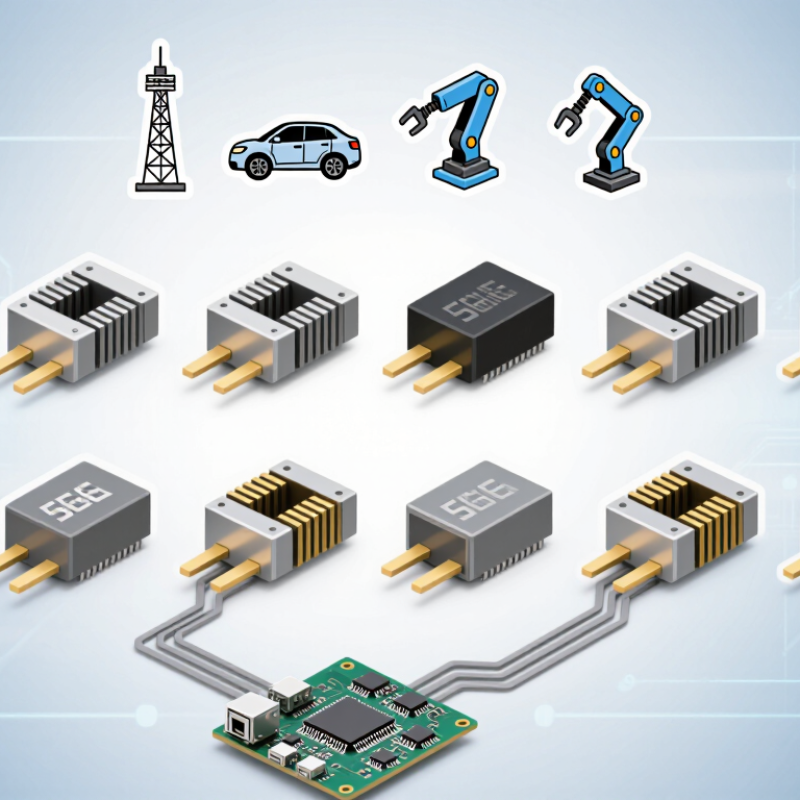
Silicon Inductors: Definition, Structure, and Operating Principles
Silicon Inductors: Definition, Structure, and Operating Principles
Silicon inductors are compact passive components built directly on, or within, a silicon wafer. They create magnetic flux when current flows through a conductive path. The stored energy resists sudden current changes. This behavior supports impedance matching, filtering, oscillation, and radio-frequency signal control.
Their structure usually includes a silicon substrate, insulating layers, metal spiral traces, contact vias, and protective passivation. Some designs add magnetic films to increase inductance, although these layers can raise losses. During operation, alternating current produces a changing magnetic field around the trace. Parasitic resistance reduces efficiency, while parasitic capacitance creates a self-resonant frequency. Above that point, the component may behave more like a capacitor than an inductor. That detail is easy to miss.
When assessing China’s top ten silicon inductor manufacturers in 2026, engineers should examine wafer technology, tolerance data, thermal behavior, and test conditions. A larger inductance value is not automatically better. Bench measurements can differ from catalogue figures, especially at high frequency. This is where careful engineering matters.
Tips: Check inductance at the intended frequency, not only at low frequency. Compare quality factor, DC resistance, and self-resonant frequency. Review aging and temperature data. If the specification seems unusually perfect, question the measurement method.
China’s Silicon Inductor Market and Key Selection Criteria in 2026
China Top 10 Silicon Inductor Manufacturers in 2026?
China’s silicon inductor market is gaining attention from automotive electronics, servers, and compact power modules. The WSTS Spring 2025 forecast expects the global semiconductor market to reach about 772 billion US dollars in 2026. This figure is not an inductor forecast, but it signals stronger component demand. China also produced more than 30 million vehicles in 2024, according to the China Association of Automobile Manufacturers. Electrification raises demand for stable, miniature passive components.
A reliable manufacturer needs more than a low quotation. Check inductance tolerance, quality factor, self-resonant frequency, DC resistance, and temperature drift. Wafer process control matters. So do test coverage and traceability. For automotive projects, review AEC-Q100-related evidence, thermal cycling results, and failure analysis records. A neat top-ten ranking can still mislead. Public data often mixes integrated inductors with conventional magnetic parts. That weakness deserves attention.
Tips: Request samples from at least three factories. Measure performance at the real switching frequency, not only at 100 kHz. Ask for lot-level inspection data, process-change notices, and delivery history. Visit the plant when possible. A polished brochure is not proof. Check the numbers yourself.
Top 10 Chinese Silicon Inductor Manufacturers in 2026
China’s silicon inductor sector will remain important in 2026. The top ten Chinese silicon inductor manufacturers should be judged by measurable engineering performance, not advertising volume. Key factors include inductance stability, DC resistance, thermal behavior, and production consistency. These parts support power modules, automotive electronics, communication equipment, and compact consumer devices.
Experienced buyers should inspect laboratory data and factory process controls. A reliable manufacturer can provide tolerance reports, sample test results, aging records, and traceable quality documents. Wafer design, packaging accuracy, and cleanroom discipline also affect final performance. Some suppliers may offer impressive samples but weaker batch consistency. That detail is easy to miss. Ranking manufacturers remains imperfect because public production data can be incomplete or outdated.
Tips: Compare at least three sample batches. Test parts near their rated current. Check performance after heat exposure and repeated power cycles. Ask whether technical support responds with measured evidence, rather than general promises. Also review delivery capacity, inspection methods, and engineering change procedures before approval. A lower quoted price may hide higher validation costs. In 2026, the strongest Chinese manufacturers will combine stable silicon processes, practical application support, and transparent quality management.
Product Capabilities, Technologies, and Industry Applications
China’s top silicon inductor manufacturers in 2026 should be assessed by capabilities, not visibility alone. A reliable ranking should examine wafer-level integration, inductance tolerance, quality factor, self-resonant frequency, thermal stability, and production yield. Thin-film and semiconductor-process inductors can reduce board space. They also support compact RF modules, power-management circuits, automotive radar, and edge-computing devices. However, higher integration may limit current handling. This trade-off is often overlooked.
WSTS reported global semiconductor sales of approximately 626.9 billion US dollars in 2024, with strong growth from computing and communications demand. That expansion supports broader use of integrated passive components. Industry reports from MarketsandMarkets also identify automotive electronics, wireless communication, and consumer devices as major inductor demand areas. Chinese manufacturers are improving automated inspection, wafer testing, and reliability screening. Important evidence includes stable inductance across temperature, high-frequency loss data, and documented customer qualification. A top-ten list can still be wrong if it relies only on factory size or public claims.
Tips: Compare measured Q-factor curves, not only catalog values. Check sample consistency across several production lots. Request reliability data for humidity, thermal cycling, and mechanical stress. For automotive projects, verify the required qualification path and traceability. A low-cost part may create higher system losses. That mistake is expensive.
China Top 10 Silicon Inductor Manufacturers in 2026
Product Capabilities, Technologies, and Industry Applications
This chart maps ten major application frequency points relevant to silicon-inductor design and manufacturing in China. The values represent nominal operating frequencies derived from widely used industry bands, including wireless power, NFC, cellular, Wi-Fi, GNSS, and automotive radar. Silicon-inductor suppliers typically differentiate through multilayer integration, high-Q performance, low parasitic capacitance, miniaturization, wafer-level manufacturing, and application-specific RF or power designs.
How to Compare Chinese Silicon Inductor Suppliers for Your Project
When comparing Chinese silicon inductor suppliers for a 2026 project, begin with verified process data, not catalogue promises. MarketsandMarkets projects the global inductor market to grow from about USD 4.2 billion in 2023 to USD 5.8 billion by 2028. Demand is moving toward smaller, higher-frequency components. Ask each supplier for inductance tolerance, quality factor, self-resonant frequency, DC resistance, and temperature drift at identical test conditions. A “10 nH” part is not comparable if one supplier tests at 100 MHz and another at 1 GHz.
Review manufacturing depth carefully. Confirm whether wafer fabrication, thin-film deposition, metallization, assembly, and final testing are controlled internally or outsourced. The 2024 Advanced Packaging report from Yole Group highlights growing reliance on integrated passive devices in compact RF and chiplet designs. This makes substrate control and process repeatability important. Request three production lots, not one attractive sample. Check lot-to-lot variation, cross-sectional images, reliability data, and traceability records. Small details matter.
Test independently. Use the same fixture, frequency range, bias current, and temperature profile. IEC 60068-based thermal cycling and humidity testing can expose weaknesses hidden by room-temperature measurements. A lower price may reflect lower yield or incomplete screening. It may not. I would still challenge that assumption. Evaluate engineering response time, corrective-action reports, export documentation, and minimum order quantities. A supplier that answers quickly but avoids raw data deserves caution. A perfect datasheet is not proof of a perfect production line.