






Choosing the best Low Noise Fan in 2026 means listening beyond the product label. A low decibel rating can help, but it does not describe every sound you will hear. Blade hum, motor tone, airflow, and vibration through a desk or wall can all affect comfort. A fan may sound gentle across a large room, then feel distracting beside a bed. Small details matter.
Soundscape scholar R. Murray Schafer wrote, “Noise is any unwanted sound.” That idea is useful here: quietness is not only a number; it is also how a fan feels in your own space. Compare sound ratings at similar distances, and check whether the fan maintains useful airflow on its quieter settings. Listen for rattles and pulsing tones, too. No fan is truly silent. Room acoustics matter.
This guide will examine practical choices for bedrooms, offices, and shared spaces, with attention to measured noise, airflow, controls, and long-term usability. It will also consider where published specifications leave questions unanswered. A test figure is only a snapshot. Real rooms are messier. The best Low Noise Fan is not automatically the one with the smallest number on its box; it is the one that moves enough air without becoming the sound you notice all night.
What Is the Best Low Noise Fan in 2026?
What Makes a Fan Truly Low Noise?
A quiet fan is more than a low number on a product label. Its sound should be measured at a stated distance and speed, because airflow settings and room conditions affect what people hear. The WHO’s 2009 Night Noise Guidelines for Europe recommend keeping indoor bedroom noise below 30 dB LAeq at night for good-quality sleep. That figure covers the room’s overall noise, not a fan rating alone. It offers useful context, not a pass-or-fail test for one appliance. A steady broadband hush may feel less intrusive than a similar-level hum with a sharp tonal edge. Loose grilles, unbalanced blades, and vibration against a desk can also add rattles. Small details matter.
Tips: Compare sound readings taken at the same distance and speed. Look for test methods such as ANSI/AMCA Standard 300, which specifies laboratory procedures for measuring fan sound. A single dBA figure rarely tells the whole story.
For a practical check, listen at the distance where you plan to use the fan. Try its lowest and most-used settings in a quiet room. Notice whether the sound stays even as the blades turn, and whether the housing buzzes on a hard surface. Specs help narrow choices, but listening conditions vary. A rating can look precise and still leave out the sound that bothers you.
| Fan Type or Feature | Typical Sound Level* | What Affects Noise | What to Look For | Best Use |
|---|---|---|---|---|
| Ceiling fan on a low setting | About 25–35 dBA | Motor quality, blade balance, installation, and speed | Stable mounting, balanced blades, and a smooth low-speed setting | Bedrooms and larger rooms where steady, broad airflow is preferred |
| Desk or pedestal fan on a low setting | About 30–45 dBA | Blade design, grille turbulence, motor vibration, and airflow speed | Several usable speed settings, a stable base, and no rattling during operation | Personal cooling at a desk or beside a bed |
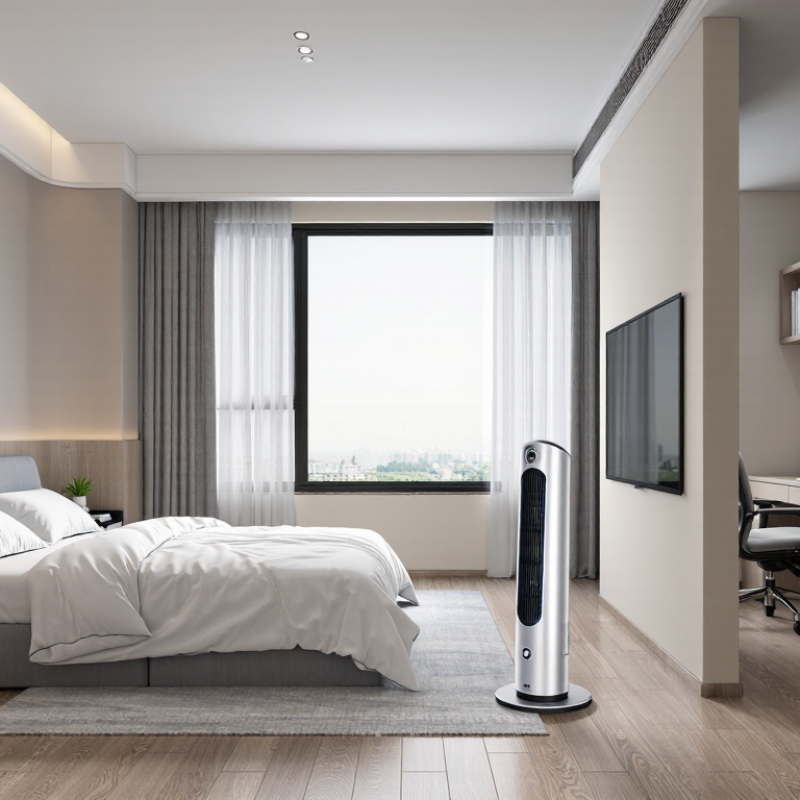
| Tower-style room fan | About 35–50 dBA | Air moving through the housing, oscillation, and fan speed | Quiet operation at the setting you will actually use; check for tones or clicks as well as loudness | Rooms where a narrow footprint and broad air distribution matter |
| Small USB or clip-on fan | About 30–45 dBA | Small, fast-spinning blades and vibration transferred to a desk or shelf | A secure mount and a low setting that does not produce a high-pitched whine | Close-range personal airflow in compact spaces |
| Motor and speed control | Varies by fan and setting | Electrical hum, motor vibration, and rapid changes in rotational speed | Listen at low, medium, and high settings; a quiet low setting is more useful than a quiet setting with inadequate airflow | Any room where the fan will run for extended periods |
| Blade and airflow design | Varies by airflow and distance | Turbulence from blades, guards, nearby walls, or objects in the airflow path | Smooth airflow without strong buffeting, fluttering, or grille noise | Quiet operation near people or during sleep |
| Build, balance, and placement | Not a fixed sound level | Loose parts, unbalanced blades, hard surfaces, and vibration through furniture or floors | Firm assembly, a stable surface, and no rattles or wobble during use | Especially important in quiet rooms and at night |
| Practical low-noise choice | Compare measured dBA at the same distance and setting | Specifications can use different distances, rooms, and test conditions | Choose the quietest fan that still provides enough airflow for the room; check independent measurements when available | The best choice depends on room size, airflow needs, and sensitivity to sound |
*Sound ranges are approximate examples, not guarantees or directly comparable ratings. Actual noise varies with model, speed, installation, room acoustics, and measurement distance. A-weighted decibels (dBA) are commonly used for sound ratings; compare figures only when test conditions are similar.
